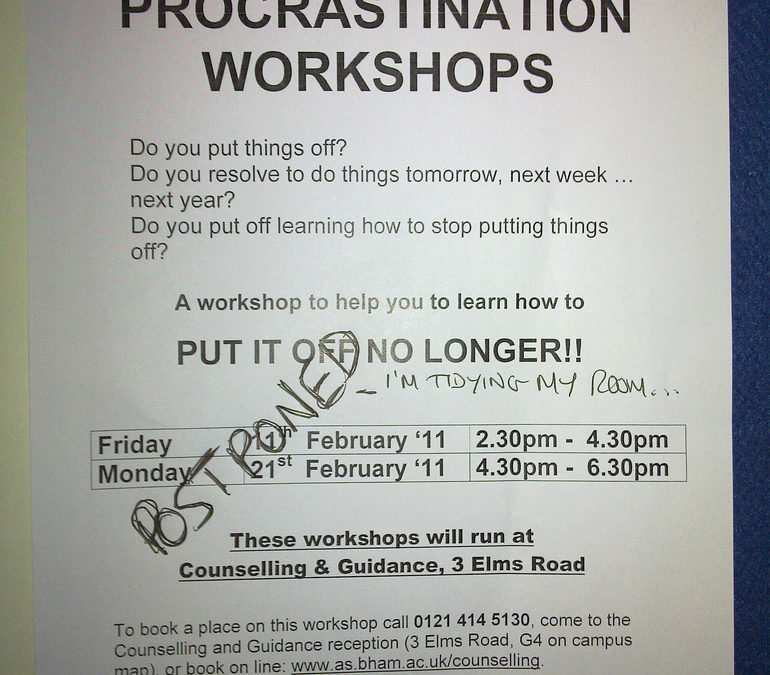
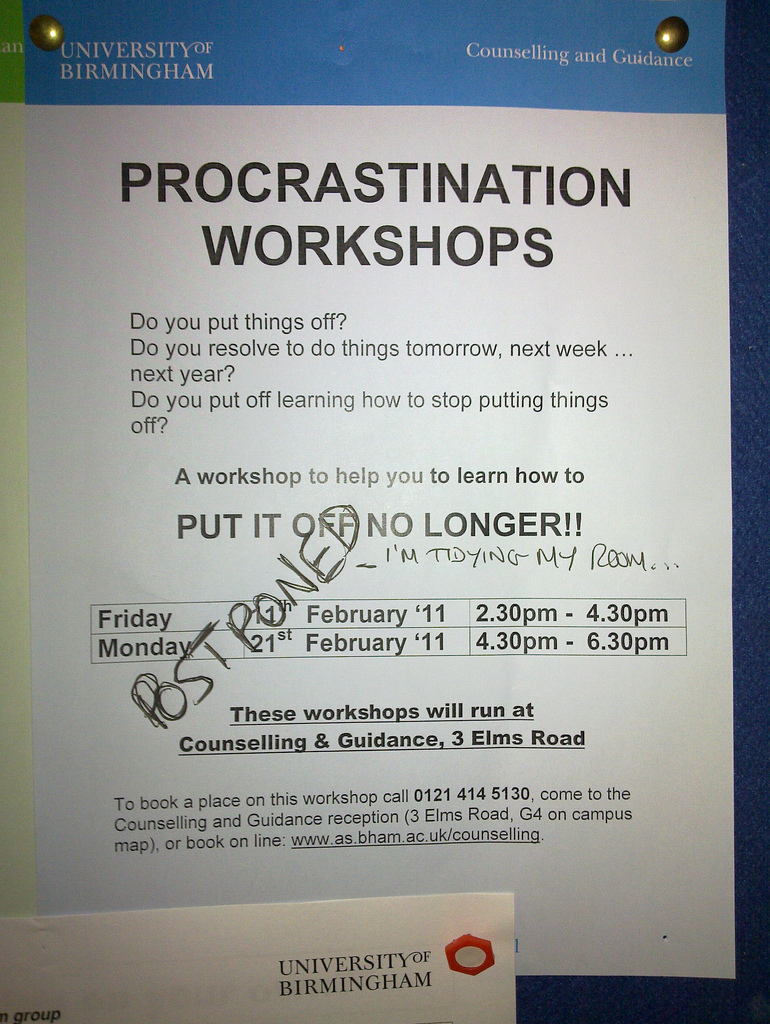
I put lots of projects off until the summer when I will supposedly have more time. My husband works teachers’ hours and has most of the summer off. He enjoys being what I call “The Crazed Cruise Director.” He has lots and lots of plans for us to have lots and lots of fun. And while we all have a good time, every fall I find myself asking what I got accomplished during the summer. The fact is, I need to stop procrastinating, imagining that I’ll be able to do it all come summer.
I see the same procrastination habit in my children. They have to get their school work and chores done during the day, but they typically wait until the last minute when my husband typically announces we are off to do something fun. Again, while we all enjoy our free time, I find myself frustrated that important work isn’t getting done.
Do you put things off until the summer or the end of the day? Do your children? Does procrastination frustrate you like it does me? If so, read on.
While I put things off, I think a lot about why I do. I wrote about procrastination that is based on our dislike for obligations. Anything we have to do, we don’t typically like to do, so we avoid it. I give you some suggestions for coping with this type of procrastination on my Not Wonder Woman blog for Christian women.
But there’s more to understanding and defeating procrastination.
First, we have to address the argument often made that we procrastinate because we work better under pressure.
Not so, say psychologists. Did we really need a psychologist to tell us the truth about our last-minute, panick-stricken work episodes? I think not. Deep down, we know that this way of working is inefficient and just plain stressful. Like any bad habit, I believe it also diminishes our self-esteem.
If we aren’t procrastinating because it’s more effective, why are we? The simplest explanation is that we will always do what is most rewarding now, rather than later. What’s most rewarding now isn’t for your child to do the math worksheet he doesn’t enjoy. What’s most rewarding now isn’t for you to make breakfast for tomorrow. What’s most rewarding now is for your child to run around pretending to be a cowboy and what’s most rewarding now for you is to surf the Web.
The reward we get for not doing the less pleasant work now can create a habit–a bad one.
Second, we have to break the habit of procrastination.
Don’t shame yourself or your child. It’s natural for us to do the most rewarding tasks first. What goes against the grain is building our skills at delayed gratification. Even though it’s challenging, you and your child can break the habit.
Take small steps. The website, tinyhabits, explains how we can be successful in changing our habits by making the changes very, very tiny. You might have your child start by doing just one math problem and you could just decide what to make for breakfast.
Reward them. We develop the habit of procrastination because it’s rewarding. To change the habit, we have to reward our new work behavior. You could congratulate your child or give him a sticker after doing one math problem. You could give yourself a piece of sugar-free gum or put an X on your calendar as a reward. Even an “Atta, girl!” can work wonders.
Make the long-term reward more visible. The reason the allure of playing cowboy is greater than doing a math worksheet is because your child can’t see the positives in being good at math. To help him, you might read from a book like Mathematicians Are People, Too: Stories from the Lives of Great Mathematicians. Or you might simply tell Dad how smart he is getting at math which will enable him to do a special math-related activity with dad (e.g., build something). For yourself, you might read a list of reasons you want breakfast made ahead of time each evening. I use my iPhone to give myself reminders at critical times for habits I want to change. I might use something like, “Remember how nice it will be to have a healthy breakfast already made when you get up.”
With just a little effort, you can break the procrastination habit in you and your child. Don’t postpone it!
How have you been able to break the procrastination habit?
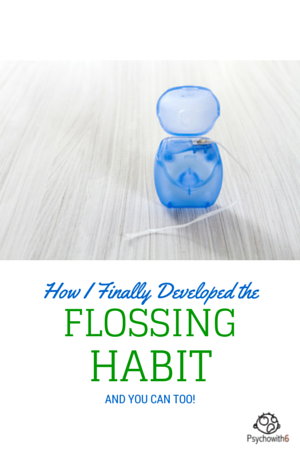
For years, every time I went to the dentist, the hygienist would be on my case about not flossing. I honestly don’t understand why I was once a flossing failure, but I do know why I’m now a flossing fanatic. I changed my habits using a simple approach that can work for you, too, whether your new habit is flossing or something even more important.
No Oprah Moments Required
I didn’t have an emotional breakthrough with flossing by recounting a horrible incident in the dental chair when I was a child. I do like talking about the time the dentist hit a nerve while giving me an injection (it was AWFUL!), however talking it out didn’t get me to floss. Oprah is a case study in the lack of relationship between understanding a bad habit and ending it. So are our pets. You can train your dog to stay off the couch without having him recline on one for psychoanalysis, thankfully. You can develop a healthy habit (or change an unhealthy one) without understanding the roots of your behavior.
Quit Looking for Motivation
I didn’t start flossing because my dentist put the fear of gingivitis in me. I do recall being motivated to floss at one time because I hoped for the approval of my hygienist. When she didn’t praise me for my months of flossing and instead criticized my technique, I quit flossing for years. I don’t know why I started again. Maybe I had something stuck in my teeth? The point is, to change many habits, you don’t need a big reason to do so.
Just Do It. A Lot.
For some reason, I flossed several days in a row. Then I thought about not flossing because I didn’t feel like it. Flossing isn’t fun and I do it at the end of a long day when I’m fatigued. But I flossed anyway. I have no idea why. Then I got serious about the potential of not flossing. While I thought about skipping, I would reach for the floss. By the time I had determined I could skip it “just this once,” I was already done. I was on automatic pilot. I’ve been flossing every night for years now and I can’t NOT do it. Reason or no, motivation or no, just do what you know you should do, day after day.
If you do what is right, will you not be accepted? But if you do not do what is right, sin is crouching at your door; it desires to have you, but you must rule over it. Genesis 4:7
Rinse & Repeat.
I’ve used this method to change a number of habits. I lock my car with the remote each time to keep from locking my keys in the car. What was once a regular problem hasn’t happened in many years. I also run my dishwasher each night. I can be dead tired, but like it or not, there I am loading, adding soap, and pushing buttons. I am currently using the same method to develop a regular blogging habit. So far, so good!
What habits have you changed with this method or what habits would you like to try it with?
If you love to read blogs like I do, you have probably subscribed to a lot of them. I have my family’s and friends’ blogs in my Google reader as well as blogs in areas of interest to me. Subscribing is easy; reading them all is hard! But I’ve found a solution that works for me. Maybe it will work for you, too, regardless of which reader you use.
Purge all blog posts from your reader. Yep, you read that right. The only reason I wouldn’t suggest you do this is if you haven’t subscribed to many blogs and you’re keeping up with what you have. But if that’s the case, why are you reading this post? Start fresh. I know some of those posts may be life-changing, but be strong and click “mark all as read.”
Set up folders based on day of the week, subject, or both. You can keep up with your blog reading by dividing and conquering. Using your reader, create folders labeled for days of the week that you know you have time to read. If Mondays are never a good day to read, don’t create a Monday folder. Alternately, you can simply create subject folders that you will then assign to days of the week. I suggest using subjects that correspond to the first letter of the week day to help you remember (Money – Monday; Teaching – Tuesday; Food – Friday). That way you don’t have to include the day in the folder label. I use both day folders and subject folders because sometimes I have a hankering to read more on a given subject, even if it’s not the day for it. I’m like that.
Assign each blog to a day and/or subject folder(s). I assign most of my family and closest friends’ blogs to every day folder. Why? Because then I won’t feel guilty when they ask, “Did you see my post on…?” Ree Drummond will never ask me that so I don’t assign Pioneer Woman to every day. Her food blog posts get assigned to Recipes and to Wednesday which is when I do my meal planning. Not sure a blog is for you? I assign those to a Try It folder.
Schedule a time to read your daily blog folder. If you don’t think about when you can and will read, you just won’t. Of course, if you’ve decided that this is all too much bother, and you don’t want to read blog posts, I’ve just done you a favor. Unsubscribe from blogs and do something more productive, like pin pictures to Pinterest. If you do want to read, then make a habit of it. The best time for me is at lunch on my iPad. I love Flipboard.
If you haven’t added Wonder Women to your reader, I’d be honored if you did! Do you have any other suggestions for keeping up with blogs?
I’m a Christian psychologist turned homeschooling mother of six. My life can be a little crazy, so I look for sanity-saving ideas to use and share. I hope you’ll read my About page to learn more.

 . Or you might simply tell Dad how smart he is getting at math which will enable him to do a special math-related activity with dad (e.g., build something). For yourself, you might read a list of reasons you want breakfast made ahead of time each evening. I use my iPhone to give myself reminders at critical times for habits I want to change. I might use something like, “Remember how nice it will be to have a healthy breakfast already made when you get up.”