I am a big fan of the Biggest Loser TV show. Unlike so many reality shows, this program really improves people's lives. I've never been obese, but I can relate to the show participants because I have been obsessed with food and my weight before and was unable to make lasting changes without God's help.
I found this DVD online and read great reviews of it. For $10, I figured it was worth a try. A 20-minute workout that could get you shredded? That was for me! I cannot even tell you how close to death I felt the first time I did it. Mind you, I am in good shape! I have been working out 4-6 days a week for a LONG time. And yet this workout had me gargling my heart as Jillian says on the DVD.
Probably the toughest part of the workout for me is it really kicks my exercise asthma into gear because it's high intensity, high impact, and no rest. Those who have never exercised would probably hate it! But if you're in shape and want a quick workout to boost your metabolism and push yourself, I can't recommend this DVD more. The only disclaimer is that she refers to the glutes with the A word, so you'll want to keep the kids from copying her. 🙂
Many wives would be insulted if their husbands brought home a Biggest Loser workout DVD for them, but when mine did recently, I was thrilled. I absolutely love surprises! He got me the Cardio workout which is easier (highly recommend it for you beginners out there). Since I started this workout, I've had several friends give it a try. Why don't you join us and let us know how you like gargling your heart?
In my grandparents’ generation, it was uncommon for moms and dads to say, “I love you.” Their generation spawned the Mommy Dearest generation, who was ready to spew forth a list of grievances against their parents at the first therapist’s invitation. Today’s parents try to do everything possible to avoid being the subject of a malicious memoir. Most say “I love you” quite frequently. Unfortunately, I think we’re still failing to communicate love. One reason is our refusal to say I’m sorry.
Words We Need to Hear…
When you think back over the worst times of your life–the relationship that ended badly, the job you were fired from, the blame you didn’t deserve, what do you find yourself longing for? When the victim’s family gathers to see the execution of their loved one’s murderer, what do they long for? I think they want to hear a heartfelt “I’m sorry.”
We Don’t Say to Others
We all long to hear these words when we’ve been wronged, yet when we’ve hurt someone, failed someone, or disappointed someone, we don’t say, “I’m sorry.” We say, “I love you.” We explain why it wasn’t our fault. Why we didn’t have a choice. Why anybody could understand if they walked in our shoes. That it’s just how we are. Meanwhile our frequent proclamations of love are giving us more divorces and failed families than any past generation.
Because of our propensity to avoid the I’m-sorry, I have quit telling anyone but my immediate family that I’ve been hurt by something someone said or did. When I have admitted to hurts in the past, thinking that this is a healthy way of managing relationships, I don’t get “I’m sorry.” Instead, the wounding party produces a voluminous list of grievances from the past decades. Apparently no “I’m sorry” is warranted if you’ve been hurt too. In the rare instances I have heard a “sorry,” it is almost immediately followed by a “but.” Or it’s a “sorry you took it that way.”
Why We Don’t Say “I’m Sorry”
Why do we refuse to admit to wrongdoing? When we don’t say we’re sorry, we carry around the guilt of our misdeeds. Perhaps we can fool others into thinking we have no responsibility for anything that we do, but we can’t fool ourselves forever. Guilt eats away at our conscience producing physical and mental disorders in addition to the destruction of our most precious relationships. Do we avoid saying the words because they make us vulnerable? They most certainly do. Negotiating conflict in relationships effectively requires vulnerability, a give and take. Some of us, however, are afraid to say we’re sorry because we think it makes our worst fears about ourselves true: I’m a terrible mother. I’m insensitive. I’m a rotten wife. A bad employee. An idiot.
Saying we’re sorry only means that we admit to doing something that wasn’t right. Saying we’re sorry actually means that we are good mothers, wives, and employees who are sensitive and smart.
I know there are times I haven’t said I’m sorry when I should have or at least as quickly as I should have. But like my parents’ generation desired to say “I love you” to give that which they missed in their own childhoods, I am determined to tell my children I am sorry regularly. They may still write a nasty tell-all book about all my failings, but at least they won’t be able to say, “And she never said she was sorry.”
Do you need to say you’re sorry to someone? Pray for the strength to do it today.
I need to organize my vanity so chose this picture for inspiration for this post. I recently got new IPhone organizational software (yes, seriously) and was inspired to write this for the AutoFocus Yahoo Group I moderate. Can you relate to my Organi-Craziness? If so, how do you cope with it?
I think I have some of your predispositions, just not to the same degree. I LOVE anything organizational–books, systems, products, software. I'm in hog heaven when I buy them and get them set up. During this process, I imagine how "perfectly" it will work for me. I will be so productive, meet all my goals, and be so orderly. Then sometime after I've used it for a while, it gets boring or tedious. So I don't use the system as described. I get upset with myself for "failing" and I commit to using it more perfectly the next day. Then as time goes on, I use the system/approach/product less and less or even less like I'm supposed to. Soon I feel overwhelmed by the backlog of not only tasks I haven't done but organizing rules I haven't followed. That's when I decide that it isn't me, but the system that's at fault. I hunt for a new system and start the whole process all over again.
This is how I'm dealing with this predisposition at present:
I acknowledge my need for frequent change. I have to change things up (buy new containers, use a different schedule, etc.) on a regular basis–not because there's anything wrong with me or the system, but just because change keeps me motivated.
I acknowledge my desire for perfection will never be met. I would love to have a day with no interruptions. I'd love to have a time management plan that works out exactly as I conceive it. I would love it if I never grew lazy. It won't happen! Enough said.
I acknowledge that having a lot to do is what gets me up in the morning. Nothing would be more depressing to me than not having enough to do. If I had my whole house organized, all my projects were caught up, and I was right on schedule, I'd probably drive to the nearest bridge. Just kidding! But it really would suck the joy out of my life. I thrive on lots to do.
I acknowledge that I can't do it all. I love AF's no-guilt approach to letting tasks go. There's no hour-long session of wracking your brain to determine what's most important, what needs to be pruned from your life, etc., etc. These less important tasks simply get dismissed by default.
I acknowledge that I will continue to be tempted to continue in my crazy organizational cycle. I am a very creative, productive person who sometimes wastes time by going off on the latest organizing tangent. If that's the worst thing I do in life, I can live with it. My goal isn't to never go organi-crazy again; it's to keep these episodes shorter and less frequent. That's a non-perfectionistic goal I think I can achieve.
I hope something in my approach strikes a chord with you.
When one of my friends saw me reading this book, she asked, “Does it just say ‘Get a housekeeper’?'” No, it doesn’t. But I understood the question. I’ve read every major housekeeping and organizational book published in the last 15 years and with a few exceptions, I’ve been disappointed.
The House that Cleans Itself by Mindy Starns Clark is hands down the best book on the subject I have ever read! Why the glowing praise you ask? Because Ms. Clark suggests you stop trying to fight nature–yours that is. All my adult life I have been trying to be organized the way naturally organized people are. I have a huge list of “shoulds” that I perpetually fail in. It’s very depressing feeling like a constant failure. Don’t get me wrong, with God’s, FlyLady’s, and Don Aslett’s help, I am probably a B student in the housekeeping and organization category. If you’ve read my book, you know that’s a far cry from the failing grade I received in graduate school.
I still long to be an A student. I don’t expect to be a virtuoso, just an A student. That’s why I bought this book that a friend recommended. I scored well on the housekeeping quiz, putting me into the category of “Use this book for tips.” I would eventually like to use her system as specified throughout my house, but I was too excited not to start immediately.
What’s So Different About A House That Cleans Itself?
So what’s so different about this approach? Before THTCI I felt like a square peg trying to fit into a round hole. Yes, I’ve shaved off some of my sharp edges over the years. I do have routines and put many things away right away. But I still have boxes of filing to do, for example. I “should” file at least once a week, right? Nope. It’s more like once a year. For half an hour. Thus my problem. Anyway, Ms. Clark suggests that while some shaving of our square edges is appropriate, we should start by creating square holes. Eureka! Now what on earth does that mean?
It means stop trying to force yourself to do things the way the naturally organized do them. Work with your natural habits. That includes dealing with husbands and children.
How THTCI Changed My Entryway
I have a coat rack next to the front door. I expected my children to behave like naturally organized children and hang their coats up on the hooks. Instead, they stuffed them into the small, unsightly laundry basket my husband put under the rack. The basket couldn’t contain all the gloves, hats, and coats so they usually ended up spread all over the floor until someone (that would be me) picked them up. I tried labeling the coat rack to no avail. There were too many coats for the rack (at least one winter coat and one light jacket per child plus adult coats).
After reading THTCI I really thought about how to solve the problem. I cleaned out my entry closet, purging it, and putting all adult coats there. I don’t mind hanging up my coat. I took Ms. Clark’s excellent advice and added a clear shoe holder to the inside of my entry door to hold gloves. Why didn’t I think of that?? I put all hats and scarves in another basket that is stored on the top shelf of the closet. The only time my children wear these is for sledding and serious outside time in the winter. There is no need for continuous access. I left the spring jackets hanging on hooks. Since the basket was removed that left two options for the coats: hooks or the floor.
Yes, I’m hopeful the kids will use the hooks now, but how can I further combat the floor throwing? I thought “a chest!” If I put a chest in my entry way they could just throw their coats in there as they came in. They’re not visible and not cluttering up the coat rack. I looked on Craigslist for a chest, but dh and I realized we had a barely-used toy box that would serve the same purpose. I couldn’t be more thrilled with our neat entryway.
How THTCI Changed My Filing System
Now what about filing? What I hate about filing is creating all the new folders and labels and deciding in what category and sub-category each thing should go in. Meanwhile all my stuff is in two boxes that I dig through when I need to find something. Could there be a solution that was somewhere in the middle?
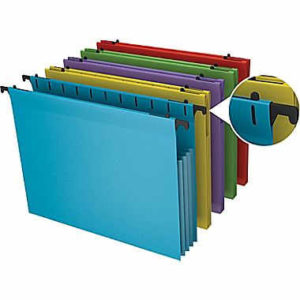
Yep! I found expanding hanging file folders in different colors. They hang wide open (and have sides) in your file box or cabinet, making sorting quick and simple. Rather than put papers into detailed files and categories, they go in major categories which are assigned a different color: to do, homeschool, writing/speaking, records, etc. As these fill up (and they hold a LOT), I will just put a new file in front of it. This approach utilizes the advantage of a lever file system (most recent papers are filed in front or to the left if using binders). I won’t have detailed files, but if I need a receipt for an appliance bought recently I’ll go to the green records hanging file in front. I’m still digging, but not nearly as deeply or as long!
This system would drive naturally organized people completely nuts. But it will work for me. I’m already completely excited about filing! I’ll be sharing other changes I make as a result of my new philosophy.
Why You Should Read The House That Cleans Itself
If you’re not naturally organized, I highly recommend THTCI. It will make you think, make you laugh, and will even help you see housekeeping from a spiritual perspective. If you are not Christian, you may have trouble relating to some of the content. I found the faith-based approach helpful and very refreshing. If you make any changes as a result of reading the book (or this blog post), please let me know!
I am still using the wonderful approach to task management espoused by Mark Forster, called AutoFocus. The instructions are now freely available here. There is a video explaining this very simple approach and I started a Yahoo group for information and support of those using it. Sign up to join us here!
I recently had the privilege of meeting with the staff of Woman to Woman, the radio program my friend Phyllis started more than a decade ago. One issue I brought to their attention was the fact that I couldn't find it on ITunes. I later found it by searching for Woman to Woman Phyllis Wallace. I was thrilled. I absolutely love being able to listen to Phyllis's soothing voice on my IPhone as she interviews interesting celebrities and experts from around the country (and even the world). I come away from every show educated, encouraged and energized! It helps that I listen to her while I work out. 🙂
After my mom, Phyllis has been my biggest fan and supporter. So many of the things I have done and experienced have been at her instigation. Yes, she's my friend, but via the radio, the Internet, and IPod, she can be your friend, too. She wants to be your fan and your supporter as she does what she does on radio so well. She wants to bring you the shows that speak to your heart and spirit. My favorite recent show of hers is "Say Good-bye to Your PDI (Personality Disordered Individual)." It is advice that is right on the money for free! Give her a listen and if you comment on her blog or send feedback via the website, tell her Mel sent you!
I’m a Christian psychologist turned homeschooling mother of six. My life can be a little crazy, so I look for sanity-saving ideas to use and share. I hope you’ll read my About page to learn more.