You were so excited the day you brought your shiny new curriculum home from a homeschool conference, the bookstore, or the mailbox. But now the school year is over, your children have grown, or you’ve decided to use something new. What’s the best thing to do with your old materials?
Or… you’ve been to a homeschool conference or you’ve been researching online and you’ve found a curriculum you’re in love with, but the price tag? A little too steep for you. Where are the best places to go to find what you need at the best possible price?
Best Places to Buy or Borrow Used Curriculum
Do you have other suggestions? Comment below. One commenter shared that she compares prices on used items at Bonavendi. Give it a try!
Your Local Support Group
You’re not a member of a local support group? Becoming a member is the first thing you should do! Click this link to search for homeschool support groups near you. Many support groups have lending libraries that are searchable online. You may find exactly what you’re looking for there for nada. But even if your support group doesn’t have a lending library, you may be able to borrow curriculum from another member. Many support groups have an online forum, Facebook, or Yahoo group where you can make your request known. No local support group where you are? Consider joining an online group, preferably for your state or region.
A Local Used Curriculum Sale
Find out from homeschoolers who know where the largest sale is near you and plan to attend. Pray that you’ll find what you need at just the right price. Earlier in the day you’ll get the best selection, but later you may get the best price. Sellers may be willing to take much less in order not to have to take their materials home.
A Local Bookstore or Library that has Materials on Consignment
An advantage to shopping a local bookstore or library is you aren’t constrained by used sale dates or times. Often the management also prices materials appropriately and won’t accept books in shoddy condition.
Amazon
Search for the books you need on Amazon, then look at the Used options. I’ve purchased numerous books at a penny over shipping and handling. You’re less likely to find complete curriculum that includes binders or audiovisual materials here. In fact, if you are ordering something like Shurley Grammar from Amazon used, make sure the CD is included. If it isn’t mentioned in the listing, contact the seller and ask.
User Groups
These are like support groups for particular curriculum in the form of an online forum, a Yahoo group, or Facebook group. Who better to buy used curriculum from than a group of people who are looking to unload theirs? User groups are not exclusive to curriculum, but are also for approaches to homeschooling. If you’re a classical homeschooler, for example, you may be able to find everything you need used from a classical user group. The Well Trained Mind Forum has listings of used curriculum. Google the curriculum or the approach you’re interested in followed by the phrase “group” or “forum” and “used curriculum.” If your child is taking an outside class, ask the instructor if materials from the previous year will be used and if s/he will help you purchase them from last year’s participants.
Ebay and Half.com
When purchasing from any used source, make sure you are getting the copyright date you want. Again, if the listing isn’t clear, make sure to ask the seller. I’ve had a good experience buying from eBay because most sellers are homeschoolers themselves. Half.com is an extension of eBay and is a better option for finding single books than it is for complete curricula. Best Homeschool Buys has a list of eBay curriculum by publisher with explanations and links to reviews. This is a great place to start your eBay search.
HomeschoolBooksForLess
Homeschoolbooksforless sells used curriculum on consignment and also donates curriculum to missionaries and needy families. I have not purchased from them, but it might be an option to consider for you.
HomeschoolClassifieds
HomeschoolClassifieds, while not having the clearest user interface, offers excellent prices on used curriculum–typically with postage included. Listing fees are free or very inexpensive which means the seller can offer materials at low cost to you.
Homeschool Trader
Homeschool Trader is a new face in the used homeschool market, but they have a really clean interface. You can often get great deals on newer sites like this one.
Homeschool Tree
Homeschool Tree is another new entry into the used curriculum marketplace. I’m most interested in their future notifications of users when a curriculum they want is listed.
Google + Curriculum Classifieds Community
Curriculum Classifieds offers the buyer more of a personal touch because of Google+’s public information on sellers.
Facebook
Joining this Facebook group allows you to buy used curriculum with less anonymity than other forums.
Homeschoolers are listing popular curriculum like Abeka and My Father’s World on Craigslist. The advantage is you can see the quality of the materials before you buy and don’t have to pay shipping. The disadvantage is you may have to trek across town to someone’s home that you don’t know. You have the same disadvantage with Freecycle, coupled with the difficulty in requesting or picking up the materials before someone else does.
Vegsource
I haven’t used Vegsource personally, but it’s a popular place to purchase used curriculum. Links to used resources by grade level are on the right of the website.
Create a “Want to Buy” Listing
Many of the above resources allow you to create a wish list of curriculum. Don’t neglect to post this on other social media you participate in, even listing the price you want if that’s important.
Paperbackswap
You’re unlikely to get current or complete curriculum at Paperbackswap, but you may get some valuable books here for the price of shipping a book of your own. I’ve gotten workbooks, many classics, and science experiment books here. Because books are not to be written in, you can feel pretty comfortable that the workbooks will be appropriate. If not, contact the “seller” and ask for a credit to be returned. Note: Paperbackswap now charges a yearly membership fee to participate.
The Book Samaritan
If your family is really in need and you don’t need curriculum from a specific publisher, consider the Book Samaritan. You only need to send a request with the grade levels of your children and agree not to sell the curriculum when you are finished with it.
Yellow House Book Rental
Renting curriculum for 10 months is another great option. Yellow House Book Rental supplies this option and others on this list to make homeschooling affordable for families.
Home 4 School Books
Jennifer shares her new site that offers used books at reasonable prices. You can find it at Discount Homeschool Book.com.
Maybe you’d like to finance your curriculum purchases for next year by selling this year’s curriculum? Maybe you just want to be able to find the dining room table for a change? Then selling or donating your used curriculum is a great idea. The same places you will find used curriculum are also good places to sell or donate it.
Your Local Support Group
You might consider listing your “for sale” items via your support group’s online forum or group. Make sure to abide by the rules. Before you sell or donate elsewhere, you may want to check any “Want to Buy” listings other members have posted. I have a couple of boxes of materials that are being donated to my support group’s curriculum library.
A Local Used Curriculum Sale
Again, determine the most successful sale in your area. Calculate the time you have to invest in working the sale and any expenses before deciding that this is the option for you. I haven’t made much for my time at used sales in the past, but I’ve enjoyed chatting with friends and have gotten good deals from other sellers.
A Local Bookstore or Library that has Materials on Consignment
Find out what the policies on consignment are and ask others who have used the particular site you’re interested in. Recognize that stores that price materials for you may under or over-estimate prices which could affect your return. It’s most important to find out how long they will keep your materials and what they will do with items that don’t sell. Calculate time required to complete any paperwork (some stores require a detailed accounting of each item) and the percentage the store will keep before consigning.
Amazon
Because Amazon is the first place I look for used books, I decided to try selling my used curriculum through them this year. Because my time is most valuable to me, I also decided to let Amazon fulfill my orders. What that means is that I input all my materials into their system, together with the prices I want them at, and then shipped them all to Amazon’s warehouse. Now when someone buys one of my used books, Amazon will ship it to them. My work is done. In a month’s time, I cleared $500 and have very few things left. To see my used curriculum, click on my Booksmark Amazon seller page. In the same period of time, I have not sold any items I listed elsewhere. I highly recommend Amazon for selling used curriculum.
User Groups
List your curriculum on forums or online groups that are associated with the curriculum or approach you use. An advantage is marketing your stuff to the people most interested in it. A disadvantage is that you will have to arrange payment and shipping with people you usually don’t know. If your child took an outside class, ask the instructor if s/he is using the same books and if s/he would be willing to help sell it to next year’s students.
Ebay and Half.com
Ebay seems to be more popular for used curriculum than half.com. If you choose to auction your materials, you may make much more or much less than you expect. If you don’t like that uncertainty, list your materials using Buy It Now. Payment for materials is more secure if you use PayPal, but you will still have to handle shipping.
HomeschoolBooksForLess
Homeschoolbooksforless also accepts materials on consignment. Be sure to read their policies before choosing to consign there. I have no experience with them and would love to hear if you do!
HomeschoolClassifieds
HomeschoolClassifieds‘ biggest advantage is the low or no listing fees. I have sold a number of items through them. The disadvantage is a cluttered home page and slow communication with buyers at times. Again, you will have to ship items. If you list as “postage paid,” you need to make sure you are allowing enough money to cover costs.
Homeschool Trader
Homeschool Trader is a newer option for sellers, but the site makes it really easy to enter your items. You’re likely to get a lot of views of your materials because there are fewer sellers to begin with.
Homeschool Tree
Homeschool Tree is another new entry into the used curriculum marketplace. I’m most interested in their future app to make listing products easy.
Curriculum Classifieds also boosts sellers’ confidence as you can “see” who is purchasing from you.
Facebook
When you join this Facebook group you will also have a little more information about who is purchasing your curriculum.
I have not sold curriculum on Craigslist, but I seriously considered it this year. The disadvantage is having to be home for buyers who may not show up or may not want your curriculum once they see it. The advantage is you don’t have to ship. Can you tell that I hate shipping things? Freecyle is another option for donating curriculum, but I would be concerned that someone is snatching up your charity only to resell it.
Vegsource
Vegsource has been recommended to me as a seller, but I haven’t used it. Please comment if you’ve used it!
Paperbackswap
Many homeschoolers use Paperbackswap and are on waiting lists for curriculum books. You can list them here and ship them to members when requested. You might even get a personal thank you! In exchange, you will receive credit in books. Be aware that you can sell your credits if you’d rather not be paid in more books.
The Book Samaritan
The Book Samaritan accepts donations for needy families. Please read their submission guidelines before shipping.
You can drop off your books at Goodwill or a charity book sale. The YMCA has a huge book sale in our area. You can also have charities come by and pick up your books in many cities. I like to donate regular books to charity, but not homeschool curriculum. Why? Because I know homeschoolers will have a hard time finding it. That’s why I don’t recommend looking at Goodwill for curriculum. Supplementary books, yes. Abeka or Sonlight, no.
I keep hearing from moms whose kids don’t like to read or don’t read as much as their mothers hope. Why the concern?
The Problem With Kids Who Don’t Read
The main cause for concern with kids who would rather do anything else but read is that they won’t become proficient readers without enough time with their noses in books. Kids who can’t read well tend to do very poorly in life, no matter how you measure. That’s why literacy is a high priority for schools and it’s a high priority for homeschooling moms, too.
While there are audio and even visual Bibles, the most accessible way to take in God’s Word is to read it. As a Christian homeschooler, I hope that my children will have the reading skills they need to read the Bible and the will to read it, too, especially when they leave home. A lesser concern where reading is concerned is our desire to have adult children who read for pleasure. Reading is a great hobby that we want to pass on!
What if Your Child Would Rather Do Anything But Read?
Assess His Abilities
Most of the time, children who are reluctant to read find it challenging. Does your child have a visual impairment, attention deficits, or a learning disability that makes reading more work? Does she need to learn to read in a different way? My reluctant reader could not learn to read phonetically, though his three older siblings did. Once I let him learn to read using sight words (or a whole language approach), his reading took off. You may need an evaluation of your child, but read the rest of my suggestions first.
Ease Your Expectations
Because so much is riding on reading, we homeschoolers can overreact to any child who isn’t reading at grade level or just doesn’t like to read. I have heard numerous testimonies of children who were late readers but caught up with or exceeded their same age peers. I can tell you numerous similar stories of people who didn’t like to read as children, but are avid readers as adults. My husband, pictured above, is a great example. He seriously read Gone With the Wind just because he wanted to! When we are fearful, we can easily become impatient and even angry about reading. Our children pick up on our attitudes easily and soon you’re in a battle of wills or you’re dealing with a child who gives up because she feels she’s not a good reader.
Keep Reading to Your Child
I didn’t understand for a long time the incredible value of reading to children in terms of building a child’s reading skills. When you read books out loud that are above your child’s reading level, he is building a vocabulary that will enable his reading to take off when he’s developmentally ready. For example, if you read a word like appreciate out loud, even if your child doesn’t see the word, when she comes to it in a book one day, she’ll sound out uh-pr–appreciate. She will recognize the word easily from a few phonics and the context. Don’t have the time to read out loud as much as you’d like? Consider a Disney Interactive Books or Audible subscription so your child can be read to any time.
Make Reading Easy
Capstone Publishers has succeeded in large part because of its focus on creating high-interest, easy-to-read books–especially for boys. No longer are readers who are “behind grade level” saddled with baby books. There are easy-to-read books on nearly every subject. Graphic novels (like comic books in novel form) are particularly appealing to boys. Calvin and Hobbes (not a Capstone title) has gotten many a boy, including mine, to love reading. You can find this book and Capstone titles at a library near you. I recommend giving your child a book at or below his reading level and telling him, “I’m not sure if this is too difficult for you or not. Let me know, okay, and I’ll find one that’s easier.” What this does is help your child save face if it is in fact too hard, but more likely your child will be thrilled to tell you that it’s soooo easy to read! When your child’s confidence is up, motivating her is easy, too.
Make Reading Rewarding
There are lots of great ways to make reading fun. Here are a few of my favorites:
Keep a steady supply of new books coming into your home. I’m married to a book salesman and new boxes of books are a source of Christmas-like excitement. You can create that kind of environment by regularly getting books from the library, Goodwill, or Paperbackswap. Ask any school librarian and she will tell you that she has to keep a steady supply of new books on the shelves to appeal to reluctant readers.
Offer a reward. My husband has often offered a shake for a certain number of books read. Lots of reading goes on at those times. While you wouldn’t want your child to expect a treat every time he reads, an occasional reward will help him see reading as the real reward.
Connect books to movies or games. Whether you offer to let your child see the movie version or play the related video game of a book before or after reading the book, this multimedia approach has been proven to promote reading.
Let your child express his creativity around a book. My kids love to dramatize books for the family. Your child may enjoy doing show and tell about her favorite book, drawing pictures to go with it, or competing in a quiz bowl with a sibling who has read the same book.
Have you been able to motivate a reluctant reader? What worked?
Home educators have a lot of demands on their time. We may have multiple children, some of whom are babies or toddlers who require extra care. Some of our children may be teens who aren’t yet driving, yet are involved in numerous outside classes or activities. Then there are homeschooling parents who have a home-based businesses or work outside the home. We want to teach our children well, but we wonder:
Is there a way of providing a quality education in less time?
Some homeschoolers think so. The idea is that you teach the essential material in just one hour a day, leaving the rest of the time for the children to do independent work, related assignments, or pursue their own interests in an unschooling approach.
What Would an Hour a Day Homeschool Look Like?
Teach one subject or do memory work for six subjects, ten minutes each
Teach four subjects (math, language arts, Bible, read aloud) for four subjects, fifteen minutes each
Teach two subjects (math, language arts) for thirty minutes each; these could be switched out daily
Teach one subject for an hour each day on a rotation
Teach an hour for older students and an hour for youngers
Teach for more than one hour using any combination above
Teach this way when you’re pressed for time
I have used the latter approach many, many times. A repair person comes, the phone rings, I have to pick someone up from the airport–you name it–and the time I have left for teaching is down to an hour. I often use the ten-minute per subject approach. Most of the time I teach for three hours using a combination of approaches. I have six children, some of whom require more intensive instruction in reading. As they mature, less of my time will be required.
But Don’t Students Need More of Your Time?
Yes, they often do. That’s why every teacher who uses this method must make themselves available to tutor and answer questions. You may be spending only an hour of focused time “teaching” your students, but they will be spending many hours relying on your tutoring and learning on their own.
Want More Information About Homeschooling in an Hour?
Check out Homeschooling-Ideas and Homeschool.com that reference a father whose six children were homeschooled in an hour a day and attended Stanford. He notes that he used this approach with older children.
You can cover many of the essentials in LESS than an hour a day with Classical Conversations.
What Do You Think? Could You Homeschool in an Hour a Day?
There are people who have impacted my life simply because they have gone above and beyond their duty. They are ordinary people whose humble service and love for others have impressed me more than anything fame, money, or position could do. The Fred Factor calls these kinds of people Freds, after a postal serviceman who went far beyond the ordinary to excellence.
Freds I’ve Met
I met Freds in an oil changing shop one afternoon. I was given a flower, had the car door held open for me, and was treated like a princess. I’m sure those Freds had no idea how profoundly impacted I was by their kindness. I cried all the way home because life hadn’t been treating me like a lady then. I met Freds at church. Two of them invited me into their home to share a delicious homemade lunch many Sundays when I was in college. The gentleman in this home handled all of my car repairs for me, making sure that he either paid for them himself or got me the absolute best price possible. Another couple of Freds invited me into their home to live when my college roommate situation wasn’t working out. I meet Freds all the time. I have a waitress who helps my children cut up their food. I have homeschool friends who come to my home for co-op who clean without being asked and jump in to help with projects that have nothing to do with homeschooling. A homeschool author read So You’re Not Wonder Womanand started promoting it on her website.
The Fred I Want to Be
I want to be someone else’s Fred. Why? Because it’s the true measure of greatness. Say Good-bye to Whining, Complaining, and Bad Attitudes calls being a Fred ‘honor.’ It’s doing more than what’s expected. The Bible calls being a Fred a servant.
The greatest among you will be your servant. (Matthew 23:11)
I realized in reading the Fred Factor that I rarely seek to be a Fred in my own home. That needs to change. I can have the greatest impact with the people I love most. That means that I am not just getting by or doing the quickest, easiest thing. It means I am giving my best for the service of my family and the glory of God.
The Freds I Want My Children to Be
Talk with your children about the Freds you’ve met. Tell them what a great impact they have had on you. Read the Scripture about what it means to be the greatest in the kingdom of God. Then discuss what they could do to be Freds in your family, in your church, and your world.
What Freds have made the biggest impact in your life and why?
Memorizing Scripture is important to me and to our homeschooling because it makes us less prone to sin, more likely to think the way God does, and better equipped to witness to our faith.
Other Bible Memory Approaches Didn’t Work for Me
My oldest was a preschooler when I started using Bible memory books with him. I was angry with myself for struggling to memorize Scripture with them, but I had a couple problems. First, the memory verses weren’t written in the Bible version I was accustomed to. Second, the books didn’t give me any other memory aids to help me learn the verses. Once the books were closed, the verses were quickly forgotten.
What is Memlok?
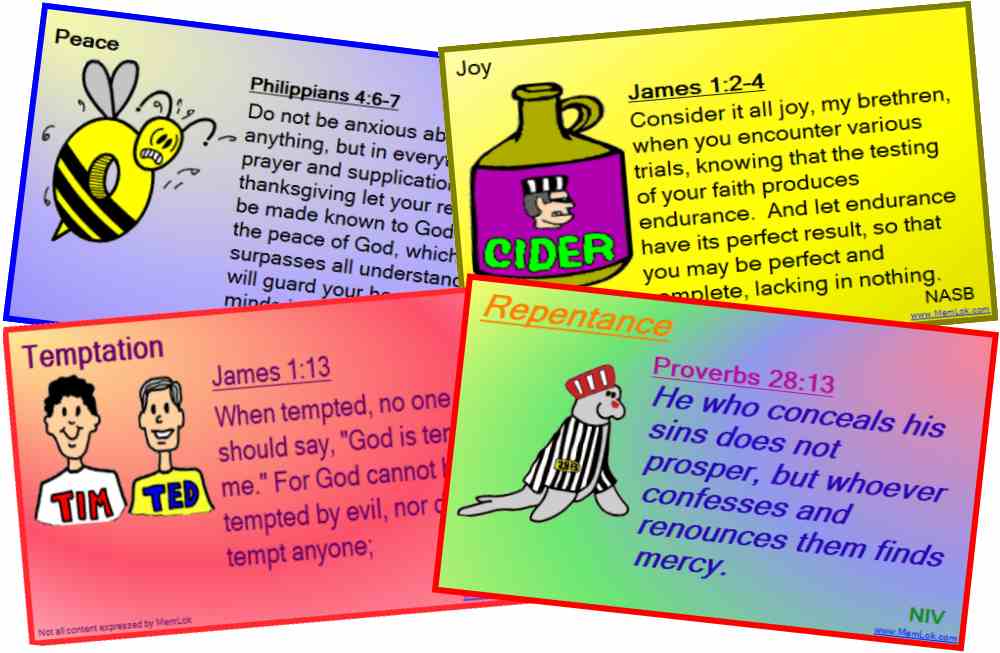
Years ago, I started a search for a means of memorizing Scripture that really worked. I looked up every form of software available, because I was convinced that the computer could help me and my children learn the Word the best. I found and began using Memlok, the only Scripture memory program that uses word pictures to help you remember verses.
The pictures were often humorous which meant that emotion aided the retention of the verses. Memlok, then and now, is a computer program (using more than one Bible version) that designed for one user at a time. As I had young children, I chose to print out business-card size flash cards that the kids and I reviewed, rather than use the program on the computer.
When my family grew, the cards were too small to see. I printed the cards out onto 8.5×11 card stock and we memorized them together that way. I posted the newest card in the kitchen where we could see it frequently. We repeated the verses together as a family and then I asked individual kids to say them, too. The real beauty of Memlok is the built-in review system that will help you remember verses forever! I kept the verses in hanging files based on when they were to be reviewed.
How I Use Memlok Today
Memlok has grown and changed just like my family. Today, I use Memlok’s computer review system on my laptop computer that is connected to our big screen TV. My kids enjoy using the new review options together (like clicking words to fill in the blank). I look forward to using the new option of creating your own pictures for additional verses I want to memorize. This means that Memlok can now easily be used in conjunction with any Scripture memory plan. Does your curriculum call for memorizing certain verses? Are your kids in Awana? Memlok is a great tool for learning those verses by heart.
I spoke with the owner of the program, Drake Mariani, by phone and he encouraged me to let my older students memorize on their own using the new mobile option for their ipods. Yep, the owner called me to talk about how I was using his program in my homeschool. Although memorizing together has worked well for us, I think independent learning is a good option, too.
Memlok is just $29.95, which includes use on any computers in your household. I have received nothing in exchange for this review. I just love Memlok and I love having committed many Scriptures to memory with my children.
What’s worked for you and your kids in memorizing Scripture?
It isn’t even summer yet, and homeschoolers are busy planning next school year. Take these ten steps to have your best year yet.
1. Inventory
Go through all of your homeschooling curriculum, books, and supplies before you do anything else. Why? So you don’t buy something you already have and also because you will get a very clear indication of what worked and what didn’t.
2. Organize
As you review each item that you’re not currently using, put it into one of four piles: 1) Using in the fall; 2) Using another year; 3) Sell/Give away; 4) Not sure. I like to store everything I am using in the current year in plain sight and everything else out of sight. This is the time of year to sell your unwanted items at used curriculum sales or online. Put “maybe” items in a separate box and review it when your school year is over.
3. Yes
Make a list of what worked well for you this school year–even if it only worked well for a while. What was it that made it successful? Newness, time of year, your energy? These are things you want to keep, return to, or build upon.
4. No
Make a list of anything that did not work for you this school year. What was it that caused the problem? Can it be fixed or does the curriculum or activity have to go?
5. Consult
Discuss your plans with your homeschooling friends. Maybe you can create a co-op, share curriculum, or share driving responsibilities. Perhaps your friends know a curriculum that would work better for you and your children.
6. Discuss
Talk about your impressions of the year with your children. They may have a different perspective on why something didn’t work or may be willing to give up other activities in order to keep a favorite. Discuss your thoughts with your spouse, even if your spouse isn’t that involved in these decisions. Often, talking it out will give you a fresh perspective. Budgetary issues should be addressed during this time.
7. Pray
Prayer can and should be a part of the entire process for believers. I sold a curriculum book for a tiny fraction of its retail value at a used sale last year, only to have a woman tell me she had prayed that she would be able to afford that very book. Our Lord wants to be involved in the smallest details of our planning and when we invite Him to be, we are blessed.
8. Schedule
One of the most common mistakes new homeschoolers (and even veterans like me) make is assuming they can handle more than they can. You will not have time to teach every subject, or even most of them every day. If you are running several days a week, you will not be able to do justice to the core subjects at home. Creating a detailed schedule will help you determine what you can reasonably accomplish.
After completing steps 1-9, you’ll be ready to make your purchase, whether you are online, at a bookstore, used sale, or a homeschooling conference. As the wife of a book salesman, please accept my encouragement to buy from someone you have a relationship with or a family business if the price is at all comparable.
One final bonus tip: start enjoying your new materials now! Why slog through the end of the year with the same-old, same-old when you have inspiring new stuff to delve into?
Are you planning next school year right now? Anything you’re struggling with or particularly excited about?
I’m a Christian psychologist turned homeschooling mother of six. My life can be a little crazy, so I look for sanity-saving ideas to use and share. I hope you’ll read my About page to learn more.