We might be able to get away with disrespecting a brat, because a brat only cares about herself. Rebel's are another story. Rebels, despite their desire to stand out from the crowd in occasionally annoying ways, demand respect from others. The less respect they get, the worse their behavior.
One particular show of disrespect that rebels hate is being ignored. When your inner rebel says something, it's best to pay attention because she will make herself heard, one way or another. When you agree to manage a project out of guilt or your desire to people please, listen to your rebel saying, "I'm not doing it." If you don't, you'll be scrambling to finish it at the last minute or worse, you'll lose face for not finishing it at all. Your rebel won't care if you lose face, but you probably will. When your rebel speaks, tell the person requesting help (even if it's you), "Let me look at my schedule and I'll get back to you." Then discuss the matter with your inner rebel. Another strategy that has worked well for me is to ask an outward rebel if the new project or new approach makes sense. If my rebel friend says, "Forget it!" I figure that's what my inner rebel is saying, too.
A second show of disrespect that revs up our rebels is character assasination. Rebels are practical, fearless, mavericks who will work like dogs on worthwhile tasks. If you tell her she's a lazy, good-for-nothing whom no one likes, you will live to regret it. Often we think this kind of tough talk motivates our rebels. It certainly does! But not in the way we want. Our inner rebels will go to extremes to prove that their approach is a good one, even when it isn't. Instead of putting yourself down for not doing what you think needs to be done, ask yourself if there is a good reason you're resisting. Often your rebel's approach is a lot healthier and balanced. If she says that you don't need to mop every night (because that's stupid), try mopping less often and see if your floor doesn't stay clean enough. If it does, give your rebel credit for talking sense to you.
A final way that disrespect operates to keep our rebels pitching fits is being unworthy of respect ourselves. Often we tell our rebels that we know better, and that Dr. So-and-So, and the Journal of Such-and-Such know better than they do. Hypocrisy, an unproven track record, or a snotty "expert" will not get your rebel to go along with you. Rebels abhor Martha Stewart even if you are crazy about her. They're more likely to love FLYLady because she's real (as long as they don't have to wear their shoes in the house). Instead of showing your rebel a picture of House Beautiful, have her watch Clean Sweep or talk to a true slob who has managed to keep things up well enough. Don't use a rich executive with a personal secretary to do her bidding as an example of what productivity looks like. Better to show her a home-based business owner who makes a decent living, but rarely takes time to dust.
The bottom line is, we have to talk to our rebels the way we talk to beloved friends, family, and co-workers who just happen to be different than we are. The truth is we can learn a lot from them!
What things have you agreed to do that your rebel (or a rebel friend) warned you that you shouldn't and she was right? What would you do differently if you gave your rebel the respect she deserves?
The first thing we are tempted to do when dealing with our inner brat is to give her some rules. Your brat procrastinated on that big project and you had to stay up all night getting it done? She hasn't taken advantage of that expensive gym membership even one time since January? She has been web surfing for hours while the laundry evolves into a leviathon?
You surmise that what your brat needs is some good old-fashioned discipline. From now on, she is going to be up at 5:45 a.m. so she can be at the gym first thing. She could have gotten away with working out three days a week if she had kept at it in January, but now that it's summer, she will be up and sweating every single day if it kills her. You don't care how tired she is after a long day of exercising, working, teaching, mothering, cooking, and housekeeping, she IS going to spend an hour working on long-term projects before she even touches the computer keyboard. And two loads of laundry must be washed, dried, folded, and put away each evening or she will not be able to read or watch TV. She'll learn, right?
The rebel that lives inside of each one of us revolts in response to rules. I have witnessed this time and time again in people I love who are more outer than inner rebels. Rules are quickly assessed as "stupid" and not applicable to them. As an outward rule follower myself, I marvel at their refusal to acquiesce, and deep down, respect them for it. Nine times out of ten they are absolutely right that the rule is wrong. If you listen closely, you will hear your inner rebel roar when you give them rules like:
Absolutely no fat, carbs, or sweets
Everything must be recorded and tagged in a to-do list
Every decent photo must be scrapbooked and journaled chronologically
Everything you eat must be weighed, measured, and recorded
Every goal must be written, shared, and broken down into mini steps
You must eat 9-11 servings of produce and drink 11 cups of water daily
You must adhere to the schedule laid out in 15-minute increments
Most people who struggle to make meaningful lasting change are dealing with an inner rebel who hates rules. Two case studies. The first is FLYLady. I wrote a Woman's Day article about her home organizing routines more than a decade ago. Although she was an immediate success, there were as many anti-FLYLady responders as there were fan girls. FLYLady's rule that women wear their shoes all day really raised a rebel ruckus. Groups of FLYLady adherents formed whose identity was simply that they refused to wear their shoes in the house.
A second case study. Mark Forster developed a system of task management that initially thrilled his rebel forum. Tasks could be accomplished simply by intuition, when they "felt ready to be done." The only problem was there were still a number of rules in the system. Immediately, the forum members objected to the rules and began proposing alternate rules. More than two years later, they are still at it.
If you are giving your rebel rules, your inner forum is revolting against you! So what are we to do? Don't we still need rules to get our rebel in line? Rules work better for rebels when:
There are few of them. That's why trying to crack down in multiple areas backfires.
There is a really good reason for the rules you have. A rebel will immediately ask, "Why should I?" You better be ready with an excellent answer!
The rules aren't merely to please people. People pleasing isn't what rebels do.
The rules aren't extreme. Rebels still believe in common sense.
The rules aren't based in fear. Rebels aren't afraid of much, especially consequences that "might, possibly" happen.
I will give you a personal example of the Rebel Rules Philosophy in action. I would like to cook healthier meals more often. So today I noted a weekly menu on AllRecipes.com that was for grilled meals, complete with shopping list. I read one review that raved about this menu and I added it to my shopping list. My kids and the cicadas outside were very noisy at the time, but I could hear my inner rebel pitching a fit. She was saying, "You're supposed to grill EVERY DAY for a week? Really? Your kids are going to eat grilled zucchini boats? Uh-huh. And you're going to make a grilled dessert every night? That is just stupid!"
So rather than do what I would normally do and buy everything I need for the grilled weekly menu, only to let the stuff spoil because I don't cook it, and then wonder why I am so lazy, I listened to my rebel. I might grill once or twice this week instead.
What kinds of rules have you given your rebels that have been resisted? Are there any rules you've laid down that have lasted?
I told my husband last night my ginormous task list for the week and I realized that I probably forgot some things. For that matter, I only gave him THIS week. But there are some real benefits to being too busy like I am now. I'm going to give you two of them. Why only two and not the traditional three? You know. 🙂
You're forced to reevaluate. From not being inclined to fritter away time, to recognizing that idle time drives your addictive behaviors, to being forced to say no, to planning and being more efficient, busy has its benefits. Like me, you've probably found you get a lot more done and are even a lot happier when you're busy than when you're not.
You realize you can't do it alone. There is no way I can do business as usual around here. I'm going to have to ask for help. Horrifying for me! 🙂 But very good for my family. And excellent for my faith. Like Martin Luther, I am so busy this week that I am really going to have to pray. John 5:3a says, "By myself I can do nothing…" And that's a good thing. It's not as much fun to do it alone.
If I weren't so busy, I would write I really great wrap-up for this post, but something's gotta go!
If this post steps on your toes, know that I'm stomping on my own feet, too. If you've followed this blog at all, you know I love to talk about productivity, organization, and time management. I don't love to do it nearly as much as I love to talk about it, unfortunately.
This morning I had an aha moment about the way I do things at home in particular. I've spoken about this in so many words before, but apparently I needed the reminder. The principle is this: if I do things differently for people other than my family, I'm living as a phony.
When I was in private practice, I often saw Christian men and women (even some pastors) who treated their families in despicable ways yet outwardly looked squeaky clean. I was honestly repulsed by this and don't feel guilty for that reaction as it was shared by Jesus. Matthew 23:25 is one example: "Woe to you, teachers of the law and Pharisees, you hypocrites! You cleanthe outside of the cup and dish, but inside they are full of greed and self-indulgence."
The point is that we are living like hypocrites when we rush around making sure the house is just-so before company arrives, yet we couldn't care less if our family has to live in a sty. The same is true if we plan lovely homemade meals for guests, but only have time for frozen pizza for our families. We're being hypocrites if we're cheerful and complimentary when a friend calls, but we're angry and critical the rest of the time.
I have had the opportunity a couple of times to have my home and children profiled for TV. As I ran around making sure the house looked good and issuing threats to the children for saying the wrong thing, I knew I was being a phony. I just tried not to think about it too much. I told myself I needed to be able to be relaxed and real in my own home. That's true enough. I am not suggesting that there aren't times when it's okay for our homes to look lived in. I remember once someone barging into my bedroom when I was nursing my first newborn. She looked at the laundry in the room and said, "Don't feel bad." I thought, "I don't."
But all things being equal, aren't there times when our family deserves our best behavior that we often save for others? I think so. Some of you may be thinking, "My home is a mess no matter who's there and I don't care." Then I have another question for those of you who are Christians. Would you care if Jesus were a guest in your home? Would He be able to say, "Well done, good and faithful servant"? If not, it's time to get rid of the baloney and make some changes. Stop making excuses and make your home a haven for those you love most. I plan to.
I have written previously about my view that one rarely-considered motivation for procrastination is the desire to avoid obligation. I have found that any time I feel required, locked in, or enslaved by expectations or rules, the less likely I am to want to complete the task. Depending upon the consequences for not completing the task, I may ultimately do the work, but will avoid doing it as long as possible.
Even pleasant tasks can become unpleasant if rules or expectations become attached to them. For example, I enjoy checking Facebook regularly to see what my friends are up to. However, as soon as I feel someone expects me to read their status and comment on their schedule, checking Facebook becomes the last thing I want to do. Why do we behave in such an irrational manner?
One reason we resist obligation-laden tasks is a desire to avoid a poor evaluation. I love to sing. But I would never try out for American Idol (even if the age range were increased) because I don’t relish having Simon tell me what an atrocious waste of time I am. In the same way, I know if someone expects me to check and comment on her Facebook status every day, I know I will one day let her down and fail. This desire to avoid a negative evaluation applies even when we give ourselves the rule. I would rather avoid the “audition” of even trying to keep up with unrealistic expectations, whether they’re my own or another’s expectations.
A second reason I suspect that feeling obligated can lead to procrastination is the assumption that anything that must be enforced by rule or stigma must not be desirable. Children who hear, “Eat your vegetables and then you can be excused,” may assume that vegetables are not good to eat. Otherwise, why would pressure be required? The opposite assumption also operates here. If we are given rules restricting access to something, then we will likely consider it something very valuable. So hearing “You can have candy for special occasions” may prompt the child to think candy is something very special indeed.
If I am right about the role of obligation in procrastination, how then might we avoid unnecessary rebellion in getting things done?
First, you might try some reverse psychology. If your habit is to wait until the last possible time to complete a project, give yourself a rule that you cannot work on the project before that time. Write out your reverse rules, share them with others, and earnestly try to adhere to them simply to see what happens. If you are spending two hours a day online and you’d ultimately like to spend less time that way, see how many days in a row that you can spend at least two hours a day online. Do you have a snack or dessert every day that you think you’d be better off without? Make it a rule to eat the same dessert every day.
Second, avoid negative evaluation. Spend as little time as possible with people who criticize and demean you. If you have to interact with them, try to get encouragement before and after you do so. If you have a really critical boss, show your work to a sympathetic coworker before turning it in, and get a pat on the back after you’ve been subject to a scathing. The easiest way to avoid negative evaluation, though, is to stifle your inner critic. Allowing internal dialogue like, “You’re such a slacker. You’re online again,” will only throw fuel on the fire of procrastination. Better to say, “When I’m ready to logoff, I will.”
An excellent way to avoid negative evaluation is to get things done early. Before anyone can ask you about a task, you'll have it done! No nagging and critical comments will be coming your way, but only surprised praise. You can enjoy your own praise for being on top of things, too. Of course, you don't have to get things done early, but you might want to.
Third, avoid rules altogether. Even adopting a rule of using reverse psychology may be something you rebel against. Giving yourself complete freedom to do whatever you wish may diminish obligation-based procrastination significantly. What that means for me is not having time management rules. I feel free to use a list or not. An iPhone app or not. A schedule or not. Avoiding rules is easier said than done. We’re constantly being bombarded with rules for living. When someone says something that makes you feel required to do something, you can dismiss it from your mind with the truth that you have a choice. Even if you are the one piling on the guilt, you will have to rethink your requirement of yourself in light of the freedom you have. One way of doing that is reframing your tasks as something you want or choose to do, rather than something you must do.
I am on a tennis team right now and am very motivated to practice regularly and improve. The coaches for the team have never suggested that I put in extra practice time. If they did make that suggestion, my initial reaction would be to procrastinate. How could I get around that? I would ask myself if the reasons I wanted to put in extra practice before their request were still valid. If so, I would choose to dismiss their expectation of me, knowing that practicing was still my choice.
While I was composing this post, my husband presented me with an obligation-laden request for help with the computer. Too bad he hadn’t read my blog first! We’re more likely to gain others’ cooperation if we keep these principles in mind. Friends can get more Facebook feedback from me by thanking me for posting, no strings attached. Of course, my initial reaction to my husband’s request was to resist, but the intensity of my resistance is much less than had I been permitting superfluous obligation to rule the day. I’m going to reframe his request as something I want to do now that I’m finished with this post. The reality is we all have to deal with a certain amount of obligation. But the more of it we reverse or avoid, the more productive and happy we’ll be.
When one of my friends saw me reading this book, she asked, “Does it just say ‘Get a housekeeper’?'” No, it doesn’t. But I understood the question. I’ve read every major housekeeping and organizational book published in the last 15 years and with a few exceptions, I’ve been disappointed.
The House that Cleans Itself by Mindy Starns Clark is hands down the best book on the subject I have ever read! Why the glowing praise you ask? Because Ms. Clark suggests you stop trying to fight nature–yours that is. All my adult life I have been trying to be organized the way naturally organized people are. I have a huge list of “shoulds” that I perpetually fail in. It’s very depressing feeling like a constant failure. Don’t get me wrong, with God’s, FlyLady’s, and Don Aslett’s help, I am probably a B student in the housekeeping and organization category. If you’ve read my book, you know that’s a far cry from the failing grade I received in graduate school.
I still long to be an A student. I don’t expect to be a virtuoso, just an A student. That’s why I bought this book that a friend recommended. I scored well on the housekeeping quiz, putting me into the category of “Use this book for tips.” I would eventually like to use her system as specified throughout my house, but I was too excited not to start immediately.
What’s So Different About A House That Cleans Itself?
So what’s so different about this approach? Before THTCI I felt like a square peg trying to fit into a round hole. Yes, I’ve shaved off some of my sharp edges over the years. I do have routines and put many things away right away. But I still have boxes of filing to do, for example. I “should” file at least once a week, right? Nope. It’s more like once a year. For half an hour. Thus my problem. Anyway, Ms. Clark suggests that while some shaving of our square edges is appropriate, we should start by creating square holes. Eureka! Now what on earth does that mean?
It means stop trying to force yourself to do things the way the naturally organized do them. Work with your natural habits. That includes dealing with husbands and children.
How THTCI Changed My Entryway
I have a coat rack next to the front door. I expected my children to behave like naturally organized children and hang their coats up on the hooks. Instead, they stuffed them into the small, unsightly laundry basket my husband put under the rack. The basket couldn’t contain all the gloves, hats, and coats so they usually ended up spread all over the floor until someone (that would be me) picked them up. I tried labeling the coat rack to no avail. There were too many coats for the rack (at least one winter coat and one light jacket per child plus adult coats).
After reading THTCI I really thought about how to solve the problem. I cleaned out my entry closet, purging it, and putting all adult coats there. I don’t mind hanging up my coat. I took Ms. Clark’s excellent advice and added a clear shoe holder to the inside of my entry door to hold gloves. Why didn’t I think of that?? I put all hats and scarves in another basket that is stored on the top shelf of the closet. The only time my children wear these is for sledding and serious outside time in the winter. There is no need for continuous access. I left the spring jackets hanging on hooks. Since the basket was removed that left two options for the coats: hooks or the floor.
Yes, I’m hopeful the kids will use the hooks now, but how can I further combat the floor throwing? I thought “a chest!” If I put a chest in my entry way they could just throw their coats in there as they came in. They’re not visible and not cluttering up the coat rack. I looked on Craigslist for a chest, but dh and I realized we had a barely-used toy box that would serve the same purpose. I couldn’t be more thrilled with our neat entryway.
How THTCI Changed My Filing System
Now what about filing? What I hate about filing is creating all the new folders and labels and deciding in what category and sub-category each thing should go in. Meanwhile all my stuff is in two boxes that I dig through when I need to find something. Could there be a solution that was somewhere in the middle?
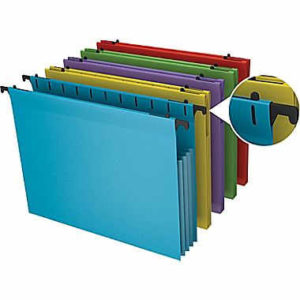
Yep! I found expanding hanging file folders in different colors. They hang wide open (and have sides) in your file box or cabinet, making sorting quick and simple. Rather than put papers into detailed files and categories, they go in major categories which are assigned a different color: to do, homeschool, writing/speaking, records, etc. As these fill up (and they hold a LOT), I will just put a new file in front of it. This approach utilizes the advantage of a lever file system (most recent papers are filed in front or to the left if using binders). I won’t have detailed files, but if I need a receipt for an appliance bought recently I’ll go to the green records hanging file in front. I’m still digging, but not nearly as deeply or as long!
This system would drive naturally organized people completely nuts. But it will work for me. I’m already completely excited about filing! I’ll be sharing other changes I make as a result of my new philosophy.
Why You Should Read The House That Cleans Itself
If you’re not naturally organized, I highly recommend THTCI. It will make you think, make you laugh, and will even help you see housekeeping from a spiritual perspective. If you are not Christian, you may have trouble relating to some of the content. I found the faith-based approach helpful and very refreshing. If you make any changes as a result of reading the book (or this blog post), please let me know!
I’m a Christian psychologist turned homeschooling mother of six. My life can be a little crazy, so I look for sanity-saving ideas to use and share. I hope you’ll read my About page to learn more.