I know. You’ve read it all before and you’ve seen it on TV. You know that you can’t get the most out of life if you have too much stuff. But you’re no hoarder. Sure, your closet and drawers and craft spaces are a bit cramped, but you’re not one of those people who never gets rid of anything.
“Why read another decluttering book?”
That was pretty much my attitude until I read the book Organizing Solutions for People with ADHD that I described in my favorite productivity books of the year post, I was completely enamored with its focus on practicality rather than Pottery Barn-beauty. After all, if it’s too much trouble to get something out of its pretty little container, you won’t use it. And if it’s too much trouble to put it back, your space will be messy in a hurry. That was me, so I was inspired to get rid of a lot of my excess stuff.
Here is why the book is not only helping me purge my home, but is helping me be more productive.
First, let me say that the spiritual aspect of the book is not for me and won’t be for most of my readers. My friend characterized it as anthropomorphic. Indeed. The author thanks objects for their service, for example. I’m all about gratitude, but I will give gratitude to Whom it is due. The majority of the woo-woo stuff is at the end of the book, thankfully, and by then you’ve come away with some real inspiration for simplifying your home and life.
#1 I’m only keeping things I love.
The author recommends asking yourself for each thing you own (especially clothing and books) if it gives you joy. For me, joy is a fruit of the spirit and not something I have as a result of wearing a particular sweater. But I got the point. I have enough clothing (and most of my readers do as well) that I don’t have to wear things that I’m not crazy about. I now ask myself,”Do I love it?”
The change that question has made is remarkable. Where I used to ask if it was “still good,” I now follow up the do-I-love-it question with “Will I wear it?” The result is I have donated or thrown away half my clothing. I was hanging on to thong underwear that I HATED, for heaven’s sake. Why? Because I had room for it. I knew I would never wear it, but I hadn’t asked myself honestly if I would. The second example was a formal dress I wore to our niece’s wedding. I wore it to a formal event for my husband’s business meeting out of the country as well. As I was packing it to take home, I realized that though I love the dress, I wouldn’t wear it again. The next formal occasion will likely be a family or business event and I won’t want to wear the same dress. I will want to buy new. So I donated the dress.
How does this apply to productivity?
First, I’m already enjoying a time savings. I didn’t realize until I got rid of so much clothing how much time I spend deciding what to wear. I’m a pretty decisive person, but when you go through things that you don’t like for one reason or another, it wastes time. Now I know that I love everything in my closet. As long as it’s appropriate for the season, I can grab and go and be happy.
The second way it applies is in principle. Just as I am not hurting for clothing, I am not hurting for free time. I do not work in a factory 12 hours a day. I don’t walk hours to get water. I am swimming in free time compared to many. So why am I spending time doing things I don’t love doing? Now don’t get me wrong. We all have to do things we don’t love doing. We have responsibilities or we can’t afford to delegate the things we don’t like to do. I’m not talking about that. I’m talking about discretionary time. Shouldn’t it be spent doing things you really love?
In the same way I asked myself if I would wear something, I am asking myself if I’m going to do it any time soon. If not, I don’t really love it (at least not right now). It needs to get off my calendar and my to-do list.
#2 My family is only keeping things they love.
The author is pretty clear on not purging for someone else (though I’ve done it without the items being missed…). Instead, I decided to teach the kids what I’d learned. I encouraged them to go through all their clothes and only keep things they really loved and were sure they would wear.
I was in awe of what happened. The kids gave away brand new clothes I had purchased for them. In the past, I would have encouraged them to start wearing these clothes so I wouldn’t feel like a fool for buying them. But it had never worked anyway. I learned that no matter how much my boys want me to shop for them, I won’t do it. They will be coming to the store, choosing clothing, AND trying it on. They ended up keeping only the clothes I see them wearing.
My husband hung out in the bedroom with us while we went through clothes. It so happens that he keeps clothing in half the boys’ closet. He has had some of the clothes there for at least 25 years! I have NEVER been able to get him to part with them, though he doesn’t wear them. This time I asked him if he loved each piece. He insisted on touching most of the clothes (just as the author suggests) and he got rid of more clothing in half an hour than he has our entire married life!
I applied the same principle to the kids’ books. If they didn’t love them and weren’t going to read them, I had them remove them from their bookshelves. Now know that I’m a book lover. Some of the books I rescued to go on the future grandma shelf. The fact is that I do love some of those books and do plan to read them again. So that counts.
How does this apply to productivity?
First, I’m saving myself some time. The younger boys protest each week that they don’t have anything to wear to church. Why? Because they have too many clothes. They can’t decide. Now that their closets hold only clothes they will actually wear, I don’t have to run to the rescue every week. This time savings will continue to accrue as I purge more and more of our unloved things. We will have half the mess to clean up!
Second, I’m teaching my children a principle that will serve them well as they manage their own responsibilities.
#3 I’m folding clothes the right way.
I thought I WAS folding clothes the right way. I had purchased these folders for the kids that allowed them to put clothing neatly away. But it turns out that I was making more work for myself. Not only does folding the traditional way obscure what you own (so you end up buying more stuff than you need), but it makes a big mess when you remove something from the drawer.
Here is a demonstration of how to fold shirts the right way!
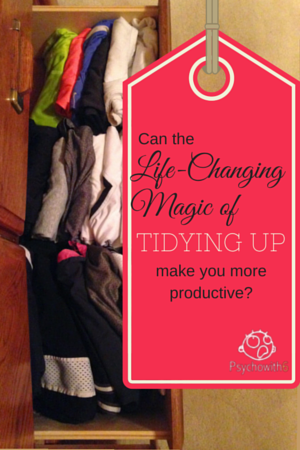
The graphic at the top of this post shows my workout clothes drawer with everything folded using this method. The bottom part of the drawer is folded more loosely because I don’t have as many shorts I love as shirts. I still have quite a few shirts, but I love and will wear them all. Promise! One thing I have noticed, though, is that I do go back and remove something I thought I wanted to keep. You will, too.
The kids took to this method immediately and love having organized drawers. In fact, their drawers look so empty that they didn’t make for good photos!
How does this apply to productivity?
First, I save time choosing clothes from my drawer and putting them away. I also don’t have to get on the kids as much about getting their laundry put away.
Second, I am realizing how important it is for everything to have an accessible space. That goes for tasks, too. One of the hacks I shared is to make sure your work space is comfortable. Make sure your tools are easy to use and put away and you will be motivated to get more done. I actually enjoy putting my clothes away and I enjoy writing every morning because the space is accessible.
If you know me at all, you know that I’m like a QVC host when it comes to talking about productivity and time management. After talking about something nonstop for a short time, something else becomes the latest and greatest thing that you just HAVE to try. I’m getting a headache just thinking about listing them all with links, so I’ll skip doing that.
The last couple of days I’ve noticed the signs that I was about to start looking for a new product to pitch. I was reading about methods I’d already tried and discarded (GTD and Toodledo) as well as a method of phone automation that would require me to get a degree in engineering to set up. I first noticed my own tendency to perpetually seek out new methods of managing tasks when I hung out on Mark Forster’s forum. Every couple of weeks there, I would post about the latest tweak or software program I was using. What’s more, the psychologist in me was fascinated by the number of people (including Forster himself) who did the same.
What’s Wrong With Me?
I’ve spent years in personal productivity “psychoanalysis” and plenty of time diagnosing others’ time management woes. Some of the factors that lead to serial program addiction include:
Overcommitment – We often switch programs to avoid dealing with the fact that we simply can’t do everything
Perfectionism – We sometimes believe (against better judgment that the right program would allow us to get everything done every day)
Comparison – We may believe that others are getting more (or more important) things done because of the approach they are using
Discontentment – We think that somehow we can have more time to do what we want if we change programs
Boredom – We may recall the last little bit of excitement we had when changing approaches to getting things done and switch gears for a pick-me-up
The Real Reason We Change our Task Management Approach
Those insights haven’t kept me from once again going down the slow road to sloth. So I asked myself WHY once again.
I immediately thought, “I need to get motivated.”
A reasonable rationale, for sure. After all, I had a whole blog devoted to motivating homeschoolers. A desire for motivation underlies all the other factors that lead to problems with our current approach. If we’re overcommitted, we feel we need to get motivated to get more done or drop some commitments. If we’re perfectionistic or comparing, we think motivation is just what we need to get our time management up to standard. If we’re discontented or bored, we believe that a good shot of motivation will be a cure-all. But for the first time, I questioned the premise. Do I really need to get motivated?
The Charles (Pa) Ingalls Productivity Approach
One of my heroes is Charles Ingalls, Pa from the Little House books by Laura Ingalls Wilder. I would love to know if he was really the incredible dad and man Laura made him out to be. I hope so! A model of productivity, he built homes and fences, farmed, hunted, traded, parented, helped his neighbors, and played the violin. Along the way, he seemed to have a lot of fun. I can’t imagine this productivity hero of mine ever saying, “I need to get motivated.” Pa saying he needed to get motivated to build furniture, make the long, cold trip to buy supplies, or harvest the hay? Laughable.
Was Pa just naturally motivated, I wondered? Perhaps he got more of the motivation gene than the average person. Maybe that was my problem. I just lack the super charge I need to get things done and it isn’t my fault; I wasn’t born with the gene.
Nah.
Like romantic love, motivation wasn’t considered necessary to be faithful in times past. Pa didn’t need motivation to do what needed to be done and neither did Ma. They didn’t read about every conceivable way to achieve their goals; they just got busy and didn’t worry about the rest. Believing that we need motivation is like thinking we need a smart phone to get things done. It’s nice, but NOT necessary.
Christians aren’t commanded to have the mind of Pa Ingalls, but the mind of Christ. What if Jesus had thought, “I need to get motivated before I feed these people, heal this man, go to the cross”? Thank God, He didn’t.
Why It Only Takes 5 Minutes to Super Charge Your Productivity
In the time it’s taken you to read (or skim) this post, you have exactly what you need to have super-powered productivity: Recognize that you do NOT need to be motivated. Nike was right: Just DO it.
If you’re still here:
Close the app store window (you don’t need a new productivity app)
I received an email from an unmotivated homeschooler this week and with her permission, I am posting it here in the desire to encourage other home educators who are in the same place and to solicit even more great feedback from you veterans.
I came across your website tonight while doing a google search… yep, I googled, “What if I love the idea of homeschooling, but I’m really not cut out for it?” I’ve been trying to do it for almost 5 school years now. My first son took two years for kindergarten because I got sick (and lazy), my second son is special needs – on the autism spectrum somewhere, and my third school-age child is my first daughter in Kindergarten, and I have a 2 year old.
My point is that I’m at that place where I really think I’m doing an injustice to them by keeping them home. I’m not getting things done, they’re lazy and it’s most likely because they see it in me. There’s a lot that goes into that, but the question remains… how do you DO what you know you need to do? How do you kick yourself in the tuckus so to speak to get the job done? I know what my calling is and what is expected of me, but I’m really struggling in getting it done…thanks for any advice.
An Unmotivated Homeschooler
I had some thoughts, but I took the issue to my Homeschool Homies (HH) and here is what we have to share with her:
Check your expectations. One of my HHs suggested that if you took two years to do kindergarten, you might be expecting way too much. Kindergarten should be a gentle introduction to math, reading, and learning in general. There are few reasons to hold your child back in kindergarten, though you can continue to work on skills at his level. In other words, are you really lazy, or do you expect to do more than is reasonable? Unreasonable expectations lead to overwhelm which can in turn lead to feeling unable to start.
Do less. When you feel like you aren’t doing much, this seems like crazy advice, but having less to do helps you do more. One HH swears by taking time to train her children to do household chores like laundry and cooking. When my children were younger, I had a housekeeper come in once every two weeks. Both strategies can free you up to spend more time teaching. Next, simplify your schooling. Set aside time-consuming, activity-heavy curriculums and do the essentials (some Bible, math, reading, and some language arts instruction–maybe some handwriting practice). Subjects like history, science, and geography do not have to be done every day and can be simply reading a great book in that subject area.
Get accountability. Being a home educator is tough for many reasons, but perhaps the biggest is we have no one overseeing our work and giving us feedback (at least in most states). Ask your husband to hold you accountable, join or start a co-op requiring preparation every week, and/or find an accountability partner. Ask an experienced homeschooler to look over what you hope to accomplish in an average day or week and let her tell you if it’s reasonable. Once you have a reasonable plan, have an accountability check-in each day or week. I use a website called idonethis.com and when I reply to it each evening with a list of accomplishments, I cc my accountability partner. Agree with your partner that if you haven’t met a minimum standard in a certain time period, that you should send your children to school.
Get support. My HHs agreed that you have a lot to handle at this stage of your homeschooling. If you don’t get together with other homeschoolers in person or online on a regular basis, may I suggest that you do so ASAP? This is a very difficult calling and we need our HHs to cheer us on. I dont know what I would do without the time to talk, laugh, and cry with my HSing pals. I really like the Hip Homeschool Moms FB page for asking questions and getting support. You may also want to consider programs that can support your homeschooling. From enrollment in online schools where all the teaching and grading are done for you to day programs and classes, you will find that you really don’t have to do it all!
I also asked my HHs how they get things done that they’re reluctant to do. Here is what they said:
I just do it. If it has to be done…
That might seem unreasonable, but sometimes we obsess over a task ten times longer than it would take to just do it. Just doing it may be setting a timer and doing it for a minimum time and then being allowed to stop. Your children will respond well to this, too.
I give myself a reward. If we get a lot of school done one day, we might go to the park the next.
One of the biggest reasons we homeschool moms get stuck doing things that aren’t school-focused is we don’t give ourselves guilt-free time. Make sure you have some every single day. Whether your older child plays with the younger while you surf the web for half an hour, you pay a sitter to come give you time away once a week, or your husband takes over at scheduled times, you will find yourself refreshed and ready to homeschool once again.
I pray about it.
Love this one. We are doing something great for the glory of God. Why would we expect it to be easy or to do it alone? God is there to help us and will certainly equip us for the work He has called us to do. My Homeschool Homies and I are praying for you!
for it is God who works in you to will and to act in order to fulfill his good purpose. – Philippians 2:13
P.S. Treat your homeschooling like a career. Develop habits and a routine (FLYLady is wonderful inspiration) or a schedule (Managers of Their Homes is excellent). Build in break times that coincide with times you’re tired. Give yourself credit for what you DO do, rather than what you don’t.
The freedom to homeschool our children is a gift. But sometimes I’ve been disappointed with this gift. How about you?
I have been certain that my homeschooled children would:
Have no difficulty learning
Be motivated to complete school each day
Take pride in cleaning and caring for their belongings
Be ahead of their same-age peers academically
Have a strong faith
Not be peer dependent, but Christian leaders
Would get along
Agree with me and my husband politically and spiritually
Not engage in immoral behavior
Be respectful and first-time obedient, especially in others’ presence
Always want to be homeschooled
Not want to date until they were ready to get married
Be capable of adult responsibilities by age 12
Not want to go to a secular college far away
To summarize, I expected my children not to behave like “other children” and to make me look good. Go ahead and laugh. You already know that my expectations are ridiculous because we can always see the problem with others’ attitudes. Our own unreasonable expectations are another story.
After more than twelve years of homeschooling and the opportunity to witness the disappointment of many dedicated, godly homeschooling parents, I now know that our children aren’t the problem–our expectations are. Invariably, when new homeschoolers ask me about their children’s lack of motivation, I discover unreasonable expectations at the source of it.
When we lay our homeschool hopes and dreams on God’s altar, we discover that we love the gift God has given us in homeschooling. Little Johnny may not be the most focused student, but he is really, really funny. Teenage Susie may not see things the way you do, but she will not be brainwashed by anyone. The kids may not be making you look good in the world’s eyes, but God thinks they’re making you look a lot more like Jesus. And that’s exactly what I wanted. How about you?
Peace I leave with you; my peace I give you. I do not give to you as the world gives. Do not let your hearts be troubled and do not be afraid. – John 14:27
When I started my simplify101 class, I thought I was going to organize one space. I wasn’t sure which one and I didn’t take the best photographs. I ended up tackling all of my kid spaces, and I wanted to share the results with my daughter’s room.
The problem here is basically that my mother’s prayers that I would have a daughter just like me have been answered. 🙂 Clothes, hair pretties, and an ugly kleenex box were issues as were wanting to keep everything on the dresser.
The swimsuit on the floor problem has been previously discussed, but notice there are no dolls in the doll furniture. They are cluttering up the closet instead.
There are multiple problems here, some of which aren’t pictured. My husband was taking up half the closet with suit coats he wasn’t wearing (no matter what he tells you). On the upper shelves of the closet were stacks of off-season and outsized clothing that my daughter would occasionally pull down, resulting in a mess. An ugly day of the week organizer was being used to store clothing that didn’t fit in her drawers and the plastic container of hair pretties (when it wasn’t somewhere else). Lots of stuffed animals and toys were overflowing the storage containers.
My daughter is too much like her mother. Regular cleaning is booooooring, but organizing is great fun. She’s quite good at it. In no time at all, she had gotten rid of many of her hair bows and stuffed animals. Together, this is what we accomplished:
Clothes hae been put away. Yay!
We moved some things from her dresser (not as many as I might like!) and I bought her a new tissue box and a mirror. With five brothers, she doesn’t get enough bathroom time! Her hair pretties are now trimmed down enough to fit inside a drawer organizer in her dresser.
Dolls in the doll furniture frees up closet space.
So did making the top bunk a home for the stuffed animals.
Unfortunately, this is a bad shot, but I want to finish this post, so we’ll stick with it! The plastic drawers from Target store doll clothing which used to float all over the closet. My husband decluttered his clothes. Yay! The large white fabric baskets, also from Target, contain outsized and off-season clothes. The basket can now be used to hold all the little goodies my daughter seems to collect. I have a flower-shaped cork board on order for her, which will also help.
I used Microsoft Word to make some labels that should hopefully prevent Little Miss from pulling these down to see what’s in them.
Finally, in going through years of the kids’ paperwork, I found this painting by my daughter when she was a preschooler that I absolutely love. I put it in a magnetic art frame from Target and put it outside her door. In case you’re wondering, we ordered her bed online. I saw it for sale painted and it was just too expensive. Then I discovered that we could order the bed mostly assembled but unpainted for much less. My husband spent a long time painting it in our garage. When we finally put it together, our UPS delivery man who had watched the progress, wanted to come in and see it! Of course, we obliged.
Hope you have some girl’s bedroom inspiration today!
My kids usually come through our side door and take their shoes off. When reading The House That Cleans Itself, I was inspired to find a real life solution for dealing with the kids’ shoes. I had tried a narrow shoe organizer in this space (it’s a very small area) and it didn’t work. The shoes weren’t put away and the organizer took up too much precious space. This inexpensive solution of hanging a shoe organizer on the wall, while not working completely (the kids don’t put their shoes in it when they walk in), does make picking up shoes a very quick affair without sacrificing space. I installed the key hanging/cork board long ago and it helps keep the keys in one place. Unless my husband takes my keys and leaves them on the curio. Or in his jacket. Or his pants. Or if I forget and leave them clipped to my purse. Anyway, you get the idea.
My Simplify101 class inspired me to consider what to do with kids’ papers. While I don’t have nearly the paperwork that families with kids in traditional schools have, I do have papers. In fact, I was ready to tear my hair out when my second son kept complaining that I hadn’t given him his memory verses from church. I HAD given them to him, twice in fact, but he kept misplacing them. The problem is that while each child has a school box for books in the basement, they don’t have a good place for papers. Furthermore, I had no place to put important papers that needed to go out the door with family members. I would often leave registration forms for my husband to take with him on the kitchen counter, hoping they wouldn’t be moved in the meantime. Invariably I would get a phone call, “Where is the ____ form?”
I know. The wallpaper desperately needs updating, but that’s a project for another day. The solution to my problem was to buy a magazine rack from Amazon. I got out my trusty label maker and made a slot for everyone, including a combined one for mom and dad. While I am not so foolish as to think anyone will put important papers in their slot on the way in, I do think it can remind them to take them on the way out. Right now, the kids’ reading club records for church are in their slots and my son’s registration forms for an upcoming mission trip are there, too. When I find these important papers, I know right where to put them and if I’m gone, I am betting the kids will figure out where to look. These magazine racks come in all different sizes and configurations. Would one of them work for you?
I’m a Christian psychologist turned homeschooling mother of six. My life can be a little crazy, so I look for sanity-saving ideas to use and share. I hope you’ll read my About page to learn more.