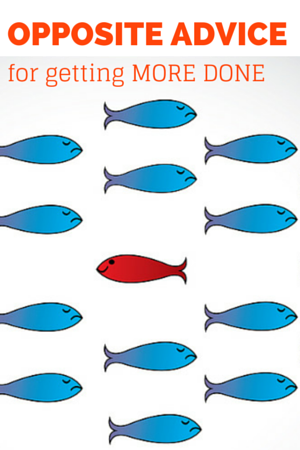
I was reading a question posed on Mark Forster’s forum about whether doing the opposite of what others generally do is effective when it comes to productivity, and I realized that I have found that it is. Here is the advice I have NOT followed with great results.
#1 Collect all your to-do’s into one trusted system.
The gurus who preach this haven’t met people like me who can produce a potential task a second.
Every time I’ve followed this advice, I’ve become overwhelmed and have shut down. It becomes impossible for me to sort out the things I must do from the things I would like to do. A someday/maybe list within the same trusted system doesn’t work for me either. I need to keep all of my ideas and potential tasks in a separate place, so I don’t become confused. Right now, all of my legitimate tasks go into ToDoist and everything else is added to Evernote. Evernote is a great place for me to put things to cool off. I find there are very few of them that I want to do anything with when I review them later.
While it’s a good idea not to have your tasks in many different places, keeping absolutely everything in one place keeps me from getting things done.
#2 Get everything done on today’s list.
I’m like so many of David Allen‘s clients who are desperate for a “win.” But defining win as getting everything done on my list for today does not work for me.
Predicting the demands on my time for any given day is as accurate as a weather forecast. Things happen. People and circumstances can keep me from getting everything done, but so can I. I have no way of knowing when I will run out of gas physically or emotionally. Of course, I do what I can to improve my energy levels, but some days I’m unpredictable. I suddenly need a nap or idle entertainment to recharge.
When I use this principle of completion to evaluate my productivity, I feel like a failure and am less motivated, not more. Instead, I schedule my tasks using Timeful and if I get MOST of my tasks done for the day, I count it as a win.
#3 Don’t procrastinate.
Of course, there are times when procrastination makes more work for us and leads to strained relationships and poor self-esteem. But I’ve learned to be grateful for procrastination.
Procrastinating has kept me from working on projects that I wasn’t committed to. Sure it would have been better if I had said no in the first place, but sometimes I don’t consciously realize that I don’t want to or shouldn’t be doing something. Procrastinating has also lessened my workload. Many times I have put off doing something only to discover that it didn’t need to be done or someone else did it. Procrastinating on purchases has saved me money as well. I buy a tiny fraction of things I add to my wish list on Amazon. I allow the desire of the moment to cool. Mark Forster’s Do It Tomorrow is contrary to the advice not to procrastinate with excellent results.
Procrastinating isn’t always a bad thing and can actually help me get more done.
I’m someone whose energy and achievement are directly tied to being challenged. I would rather delegate many things I AM good at, because they’re boring and tedious. Things I’m not good at inspire me. I want to learn how to do them so I can get more done. A second problem I’ve found with delegating things I’m not good at is I lose control. My productivity slows down on specific projects as I wait for the delegated work to be done. I can also be taken advantage of by people who know more than I do, because they can tell me how long something will take and how much it will cost and I won’t know any better.
While delegating is the right choice in some circumstances, I’ve found that much of the time I shouldn’t delegate what I’m not good at.
#5 Don’t change systems frequently.
The typical advice is to find one approach to managing your tasks and stick with it. Fiddling with your system just wastes time, the gurus say. But as someone who intentionally changed systems nearly every week during A Year of Living Productively, I learned that doing the opposite has been very effective for me.
Looking back at the times I’ve changed approaches to tasks, one thing is clear: I didn’t make changes during times of high productivity. Instead, I made these changes when my productivity and motivation were low. I would read a new book, try a new app, or scour the Internet for a new way of thinking about work and BAM, my productivity would dramatically increase. I got out of bed excited to use my new system and found myself getting twice as much done.
Rather than being a means of wasting time, changing systems has been a consistently effective way for me to get more done.
How about you? Do you do the opposite of the standard advice with good results?
This is a guest post by Tim Sprosen from the UK who is a medical researcher at the University of Oxford, a husband and father and writes about his productivity journey at www.timsprosen.com. In this post, Tim returns to the wisdom of Covey’s 7-habits to remind us all that being productive is not just about getting things done.
Stephen Covey’s 7-Habits of Highly Effective People was first published 25 years ago and I can still recall the day when I picked it up from a newsstand at Chicago’s O’Hare airport before catching a flight back home to London. This book had a profound impact on my approach to time management. As well as providing a practical framework for personal organization, where Covey clearly identified the next seven days as being the ideal period of time to plan and organize – the genesis of the weekly review – the book also recommended taking a very top-down approach to organization.
What that means is working out first and writing down what is important to you before dealing with the day-to-day tasks and other demands on your time. Unfortunately, as I recently pointed out, so much discussion of productivity today and, in particular, the false hopes of technology – what I call the app-trap – is entirely focused on task management. It is like we are relentlessly trying to run a little bit faster without first stopping to work out where we are heading (and also who we are heading there with – keep reading…).
But, what I think was really ground breaking about the book, particularly at a time when so much of the “success” literature was only concerned with money and material things, was the focus on building character and being more concerned with people rather than things. In practical terms, this meant drawing up a mission statement that included identifying the key roles in your life and then on a weekly basis reviewing each of these roles and setting the key things you want to achieve in that role for the coming week. While I am no fan of the concept of work-life balance, organizing your week around your key roles really helps to bring actual balance to life.
Let me give an example. Let’s say the coming week I am traveling with work and will be away from home. Looking at my role as a husband and a father, I might set goals in those roles to book a table to have dinner with my wife when I return home and in the role of father I might make a note to pick up a gift for each of my children while I am away. Then when I look at my role of son this reminds me to make a note to call my mum before I go away. This simple list of my key roles, which I look at each week, really serves me well and like any productivity tip, it means I don’t need to worry about trying to keep these reminders in my head.
So, for the week ahead, try looking at the things you want to get done not just in terms of your tasks and goals, but also through your key roles. Why I invest time in my personal productivity is very simple; it is to spend more of my time and energy on those people and things that matter most to me.
[Melanie here. I couldn’t agree with Tim more and his post was very timely for me. Was it for you?]
Mark Forster’s link to Jim Perry’s article, “Structured Procrastination,” got me thinking. Jim suggested that we procrastinate doing tasks that are more important by completing tasks that are less important. He had a point. I often find myself doing just about everything but what I should be doing. But I disagree that it’s primarily the importance of a task that gets my procrastination process flowing.
We all know that the size, difficulty, or unpleasantness of a task can prompt procrastination. Mark’s book, Do It Tomorrow, offers wonderful suggestions for coping with this kind of task resistance. But I believe there is another factor at play: obligation. That is the gist of what I wanted to say. Please don’t feel obligated to read further.
Examples of Obligation-Based Procrastination
When I was in sixth grade, I took piano lessons. Each week, I would meet with my piano teacher and tried to fake my way through the assigned pieces that I had not practiced. I hated that I had to play certain songs for a certain period of time, even though I enjoyed the piano. Finally, I convinced my mom to let me quit. From that day on, I sat and played piano for about an hour a day.
As a psychologist, I have seen couples’ sex lives demonstrate the same principle. A physical relationship can become nonexistent because of the obligation one partner feels to participate. The “treatment” I used was to forbid both partners from initiating intimacy for a couple weeks. The result was that the obligated partner was all over her spouse in no time.
As a homeschooling teacher, I have seen this principle at work in my children. The boys loved their computer science assignments and would do several lessons in one sitting. That is, until I assigned them a lesson a week to check off in their notebooks. Suddenly, nothing could get them on the computer. Hm. Maybe I need to assign a daily video game?
I propose that the more obligated we feel to complete a task, the more likely we are to procrastinate doing it. Significant rewards or punishments can override the power of the obligation-procrastination connection. No matter how obligated or put out you felt, you would probably not procrastinate going to pick up a check for your million-dollar lotto winnings. Likewise, the threat of missing the plane and not catching another one keeps people from extreme procrastination when it comes to leaving for the airport. Well, some people.
Without realizing it, people who use obligation (read guilt) to motivate in relationships often get the opposite of what they were hoping for. The mother who makes her son feel obligated to call gets fewer calls. The blogger who complains about lack of comments gets fewer comments. The wife who pouts about lack of romance gets none.
Why Obligation Produces Procrastination
I have long been enamored with the four-personality-type model described by Florence Littauer in Personality Plus. I believe personality explains much of why we eschew obligation. Powerful Cholerics desire control. Obligations feel like loss of control to this personality type. This explains why my Choleric husband refused procrastinated writing his agenda on our family calendar. Obligations are particularly conducive to procrastination for this personality type.
Popular Sanguines just wanna have fun. Obligations are automatically not fun. If someone is requiring you to do something (even if it’s you), it must be something to be avoided. Although the Choleric is likely to refuse an obligation-laden task, Sanguines are likely to do it at the very last minute for fear that you won’t like them if they don’t.
Peaceful Phlegmatics just want to feel valued in a life that is easy and peaceful. Obligations that create conflict will be avoided. This personality will often do obligatory-tasks if they’re quick and easy. But effort-laden tasks coupled with an I’m-superior-to-you attitude is sure to invite procrastination.
Perfect Melancholies are least likely to be affected by obligation-related procrastination. The Melancholy, by his nature, feels obligated to perform tasks perfectly. This attitude does not keep him from doing the work. In fact, he rarely procrastinates as procrastination is an imperfect work habit.
How to Be Free From Obligation-Based Procrastination
So how can we manage the obligation-procrastination cycle, especially given that many obligations emanate from others?
First, remove obligations if possible. I was paid for doing premarital counseling at my church for many years. The paycheck made me feel obligated. As a result, I put off many tasks related to this position. I asked that I be made a volunteer instead. With the obligation removed, I was much more productive in this role. Perhaps you simply don’t have to do what you are avoiding doing.
Second, reassign obligations. Some obligation is perceived when no one else is taking on what we view as a necessary responsibility. Tasks like cooking, cleaning, and other chores can create obligation-inspired procrastination if one feels the work has been left to you. Your family members or office-mates may not seem to care if you complete these tasks, but if you care and aren’t getting any help, procrastination can kick in. The solution is to discuss your dilemma without placing blame or obligation on those who may be very willing to help.
Third, work ahead. (Notice that I don’t feel obligated to continue with the re- words.) The closer and closer a deadline looms, the more obligated we feel. That is why we engage in seemingly nonsensical behaviors like watching TV when we have a major paper or project due the next day. If we follow the time-honored advice of beginning early on projects, we feel no obligation. In fact, we feel superior for being so far ahead on our work by choice. If you have a project deadline coming up soon (tomorrow) that you’re going to procrastinate on anyway, go ahead and start working on a project that isn’t due for months! You know you’ll stay up late, imbibing tons of caffeine, and get your obligatory work done anyway. (Yes, that is a little reverse psychology.)
Fourth, refuse to accept obligations unless absolutely necessary. Committing to specific dates or expectations for a project may get you procrastinating. Instead, be a noncommittal volunteer whenever possible. I love writing, but give me a deadline with a picky editor and you can be sure that I’ll be doing a lot of web surfing rather than writing. The reason I am writing this article today is because I have absolutely no obligations associated with it. I can write it whenever, however I would like to. An easy way to refuse self-imposed obligations is not to add a task to your to-do list. The task may then become a “want to” rather than a “have to.” This would only be effective for tasks that you won’t forget. This lack of obligation may explain the popularity of the Getting Things Done philosophy. Tasks are collected and sorted into contexts (at phone, at computer, at office, etc.), but there is no commitment to do tasks without deadlines today. You can choose what you want to work on (for the most part) guilt-free.
Fifth, rethink obligations. When we’ve used the first four approaches and we’re still faced with an obligatory, procrastination-producing task (or the threat of being fired), we can change how we think about it. For example, FLYLady calls weekly cleaning the “home blessing.” The language we use in our heads and in our spoken words has a huge impact on how motivated we are to complete certain tasks. Consider your emotional reaction to the words “responsibility” and “privilege.” Which of these two types of tasks would you be most likely to complete? So many of our “responsibilities” (like grocery shopping, caring for children, home maintenance) are what millions of destitute people would consider privileges. Adopting a grateful perspective can help us get the job done today.
I hope these suggestions will free you from procrastination. But please don’t feel obligated to put any of them into practice. If you’d like to comment on them, feel free to do so whenever you like. I’m off to do something else I don’t have to do.
I’m a Christian psychologist turned homeschooling mother of six. My life can be a little crazy, so I look for sanity-saving ideas to use and share. I hope you’ll read my About page to learn more.