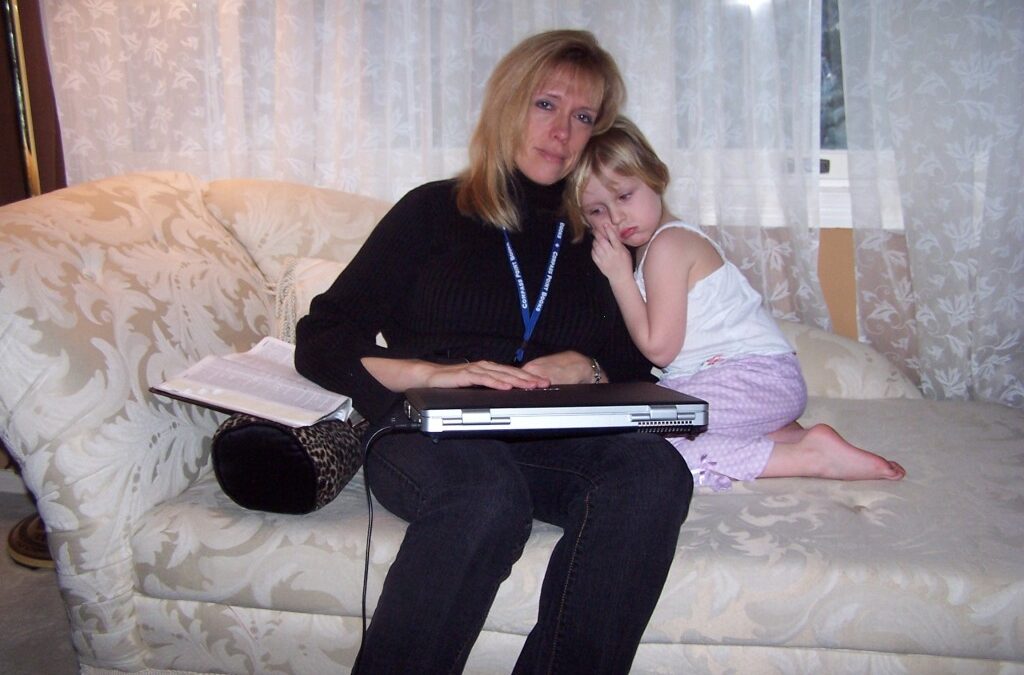
Home educators have a lot of demands on their time. We may have multiple children, some of whom are babies or toddlers who require extra care. Some of our children may be teens who aren’t yet driving, yet are involved in numerous outside classes or activities. Then there are homeschooling parents who have a home-based businesses or work outside the home. We want to teach our children well, but we wonder:
Is there a way of providing a quality education in less time?
Some homeschoolers think so. The idea is that you teach the essential material in just one hour a day, leaving the rest of the time for the children to do independent work, related assignments, or pursue their own interests in an unschooling approach.
What Would an Hour a Day Homeschool Look Like?
Teach one subject or do memory work for six subjects, ten minutes each
Teach four subjects (math, language arts, Bible, read aloud) for four subjects, fifteen minutes each
Teach two subjects (math, language arts) for thirty minutes each; these could be switched out daily
Teach one subject for an hour each day on a rotation
Teach an hour for older students and an hour for youngers
Teach for more than one hour using any combination above
Teach this way when you’re pressed for time
I have used the latter approach many, many times. A repair person comes, the phone rings, I have to pick someone up from the airport–you name it–and the time I have left for teaching is down to an hour. I often use the ten-minute per subject approach. Most of the time I teach for three hours using a combination of approaches. I have six children, some of whom require more intensive instruction in reading. As they mature, less of my time will be required.
But Don’t Students Need More of Your Time?
Yes, they often do. That’s why every teacher who uses this method must make themselves available to tutor and answer questions. You may be spending only an hour of focused time “teaching” your students, but they will be spending many hours relying on your tutoring and learning on their own.
Want More Information About Homeschooling in an Hour?
Check out Homeschooling-Ideas and Homeschool.com that reference a father whose six children were homeschooled in an hour a day and attended Stanford. He notes that he used this approach with older children.
You can cover many of the essentials in LESS than an hour a day with Classical Conversations.
What Do You Think? Could You Homeschool in an Hour a Day?
Because I’m a Wonder Woman, I have a lot going on. Maybe you can relate. On a regular basis, I wonder what’s most important in my life, my week, and my day. Should I be spending more time:
Unfortunately, the answer always seems to be YES. They all seem to be important, worthwhile activities. And although I have written about the JOY method for prioritizing my time, the truth is I still struggle on a daily basis with what’s important.
The Bible records the question of a man who was an expert in the law who wanted to test Jesus, but it’s a question I am asking in all sincerity. What’s most important?
36 “Teacher, which is the greatest commandment in the Law?”
37 Jesus replied: “‘Love the Lord your God with all your heart and with all your soul and with all your mind.’[a]38 This is the first and greatest commandment. 39 And the second is like it: ‘Love your neighbor as yourself.’[b]40 All the Law and the Prophets hang on these two commandments.” (Matthew 22:35-39)
I have discovered the power of asking a simple question of my bickering children. I don’t tell them what they said was wrong, against the rules, or punishable. I simply ask, “Was what you said loving?” The question has never failed to elicit an honest response. No matter how upset the guilty party is, there is a hanging of the head and a repentant, “No.”
What’s Most Important?
As I’ve struggled lately to determine which to-do’s are most important on my long list, I find that asking myself, “What’s the loving thing to do?” gives me clarity and peace. I look at my husband who’s wondering what’s for dinner while I try to improve my blog design and I know the loving thing to do. As I wonder how to increase my blog readership while quickly scanning others’ posts, I know the loving thing to do. I see my children playing ball outside while I fret about me, me, me, and I know the loving thing to do.
I’m finishing this blog post as I hear my husband and children making plans for active fun. I know the loving thing to do.
If you have not visited her blog, I think you’ll find it like a chat with a Wonder Woman who’s seen more than her fair share of bad situations, but lives in victory through Christ. I hope you enjoy my post and your time on Counting My Blessings.
In case you’re wondering, we were at the beach when my oldest son threw a baseball right at his sister’s face. It was an accident, but it made for a pretty comical family photo.
A blogger who ministers to busy women asked me to write a guest post on over-commitment. When I got her email, I laughed out loud. I think God was trying to tell me something and He needed to be blunt.
The resulting post on the high cost of over-commitment ministered to me and I pray it will minister to you. While you’re visiting beautiful Daphne’s blog (I mean, she’s model beautiful!), please subscribe and be blessed by her beautiful spirit as well.
Twelve years ago I gave birth to my third son. In my heart of hearts, I knew he was a boy before the doctor said so. What I didn’t know was how much I would be affected by the knowledge that I would never have a daughter.
My husband and I wanted two to three children when we got married. When boys number one and two arrived, I assumed baby number three would be a girl. I was the oldest with two brothers. Every family I knew growing up either had both genders or all girls. The baby dolls I played with were girls. I never seriously considered that I would have an all-boy family. Until that’s what I had.
The Truth is Taboo
I knew immediately that I couldn’t tell a soul that while I was crazy about my beautiful, healthy newborn son, I was sad about the daughter I would never have. If I were honest about how I felt, people would accuse me of not being grateful for my children or not trusting God or not even being a good mother. After all, there were women in China abandoning babies of the less-preferred gender, weren’t there? To say that I wished for a daughter in addition to my incredible sons was a sin. And so I was silent and I grew very, very depressed.
One thing we know from studying veterans of wars and victims of crime is that if hurting people don’t express what they’re feeling, they are at risk of depression, post-traumatic stress disorder, and worse. As I continued to deny my feelings, the stress I was under in parenting three boys ages three and under escalated.
Thankfully, I found a group of women online who felt like I did–women who, like me, assumed they would have a child of both genders, but didn’t. Also, like me, they wrestled with guilt for feeling as they did and with the unwritten rule that you didn’t talk about how you felt. As I got to know these mothers, I learned two things that are important for mothers with the baby gender blues:
You have to talk about it. You might not be able to tell your mother, your in-laws, or even your best friend, but there is another mother out there who knows what you’re going through. Be honest with her about how you feel.
Let go of the guilt. Needing time to adjust to a different plan than you envisioned is not wrong. In fact, the more guilty you feel, the longer the adjustment time.
Others’ Comments are Unkind
When I thought I was adjusting well to the idea that I wouldn’t have a daughter, someone would say something that would set me back. Here are just a few of the things I heard and what I thought:
I just can’t imagine not having my daughters. (She thinks my life will be awful without one.)
I just don’t see you being the mother of a daughter. (I’m not good or girly enough to have a daughter.)
I just got lucky having a girl after having boys. (I’m not lucky.)
That is so, so sad that you don’t have a girl. (There’s no bright side.)
Boys don’t take care of their parents. (I’ll be lonely in my old age.)
You only get to be involved in weddings and with grandkids with your daughters. (I’ll be left out of my kids’ lives.)
With the help of friends who experienced similar unkind comments, I learned two more things that can help mothers with baby gender blues:
People say stupid things that simply aren’t true, even if they believe them. I was blessed with a very close relationship with my mother-in-law. I knew that God willing, I could be close to daughters-in-law, too. I also knew families of all grown boys who took great care of their elderly mother and I knew grandmas with only sons who were very close to their grandkids. Look for the exceptions to these ridiculous rules. You’ll find them.
People often have ulterior motives for what they say. People who are jealous of you will use what they suspect is a disappointment to their advantage. People who are hurting about their own family will often want the company of your misery. Consider the source. Are the people who love you best encouraging you? Listen to them.
My husband and I had three more children, the fifth a daughter. But having a daughter hasn’t changed my compassion for women with the baby gender blues. I remember that time in my life well.
To be supportive of a mother of one gender:
Don’t assume they’re upset. Not everyone is disappointed.
Don’t express sympathy. If you’re close, ask the mother how she feels about the baby’s gender and respond accordingly. If you’re not a confidant, don’t mention it.
Don’t tell her gender doesn’t matter. You’ll contribute to her guilt.
Compliment mom and baby. Tell her how beautiful her child is and what a great job she does in parenting.
Share positive examples. People who told me about adorable families with all boys were my heroes. My pediatrician made me smile when he said, “You’ll always be the queen.”
Use humor. When we learned that baby #4 was a boy, too, our brother-in-law said we might as well remove all the toilet seats. I should have taken his advice.
those who hope in me will not be disappointed. (Isaiah 49:23b)
While we may experience temporary disappointment in all aspects of life, we will never be disappointed in the God who loves us and will never leave us.
Has anyone said anything hurtful about the gender of your children or have you inadvertently said something to a parent with all boys or girls?
There are people who have impacted my life simply because they have gone above and beyond their duty. They are ordinary people whose humble service and love for others have impressed me more than anything fame, money, or position could do. The Fred Factor calls these kinds of people Freds, after a postal serviceman who went far beyond the ordinary to excellence.
Freds I’ve Met
I met Freds in an oil changing shop one afternoon. I was given a flower, had the car door held open for me, and was treated like a princess. I’m sure those Freds had no idea how profoundly impacted I was by their kindness. I cried all the way home because life hadn’t been treating me like a lady then. I met Freds at church. Two of them invited me into their home to share a delicious homemade lunch many Sundays when I was in college. The gentleman in this home handled all of my car repairs for me, making sure that he either paid for them himself or got me the absolute best price possible. Another couple of Freds invited me into their home to live when my college roommate situation wasn’t working out. I meet Freds all the time. I have a waitress who helps my children cut up their food. I have homeschool friends who come to my home for co-op who clean without being asked and jump in to help with projects that have nothing to do with homeschooling. A homeschool author read So You’re Not Wonder Womanand started promoting it on her website.
The Fred I Want to Be
I want to be someone else’s Fred. Why? Because it’s the true measure of greatness. Say Good-bye to Whining, Complaining, and Bad Attitudes calls being a Fred ‘honor.’ It’s doing more than what’s expected. The Bible calls being a Fred a servant.
The greatest among you will be your servant. (Matthew 23:11)
I realized in reading the Fred Factor that I rarely seek to be a Fred in my own home. That needs to change. I can have the greatest impact with the people I love most. That means that I am not just getting by or doing the quickest, easiest thing. It means I am giving my best for the service of my family and the glory of God.
The Freds I Want My Children to Be
Talk with your children about the Freds you’ve met. Tell them what a great impact they have had on you. Read the Scripture about what it means to be the greatest in the kingdom of God. Then discuss what they could do to be Freds in your family, in your church, and your world.
What Freds have made the biggest impact in your life and why?
I’m a Christian psychologist turned homeschooling mother of six. My life can be a little crazy, so I look for sanity-saving ideas to use and share. I hope you’ll read my About page to learn more.