Humor is a great way to motivate kids to write. When we give kids freedom to write what they think is funny (as long as it isn’t hurtful or offensive), they can discover the joy in writing. While some of these writing prompts aren’t funny in and of themselves, they open the door for your student’s comedic genius.
Get the Printable Prompts Here. Subscribers will find the printables in the folder linked at the bottom of your email. Just like the funny fall writing prompts I created, these writing prompts are appropriate for all ages. Younger kids can dictate their writing to you. These are the kinds of cute papers that will be keepsakes! New writers will appreciate the printables I’ve created for subscribers with colorful pictures and handwriting lines. Older writers can use their own paper or type their responses.
These winter writing prompts include Christmas and Valentine’s Day topics
Five things that wouldn’t make good Christmas gifts are:
Make up a recipe for fruitcake that explains why few people like it.
Write about who the Gingerbread Man would run into in your neighborhood and who would end up eating him.
Write your ideal Christmas Day schedule
Write a nice thank you note for an ugly Christmas sweater
Write a letter from a snowman to a weather forecaster complaining about the warm temperatures
If snowflakes could talk, they would say…
If you had the power to freeze things like Elsa from the movie Frozen, how would you use your power?
Describe a sled ride down a hill from a dog’s perspective
Write lyrics for the song a love-sick cat would sing
Create the perfect candy for Valentine’s Day, listing ingredients and directions
Describe a cold to someone who’s never had one before
Click the Graphic Below to Access the Printables
You’ll also receive tips for teaching kids to write funny. (You know what I mean.) Or get the printables here.
If your child writes something really funny, share it with me at psychowith6 at gmail dot com and I may share it on the blog.
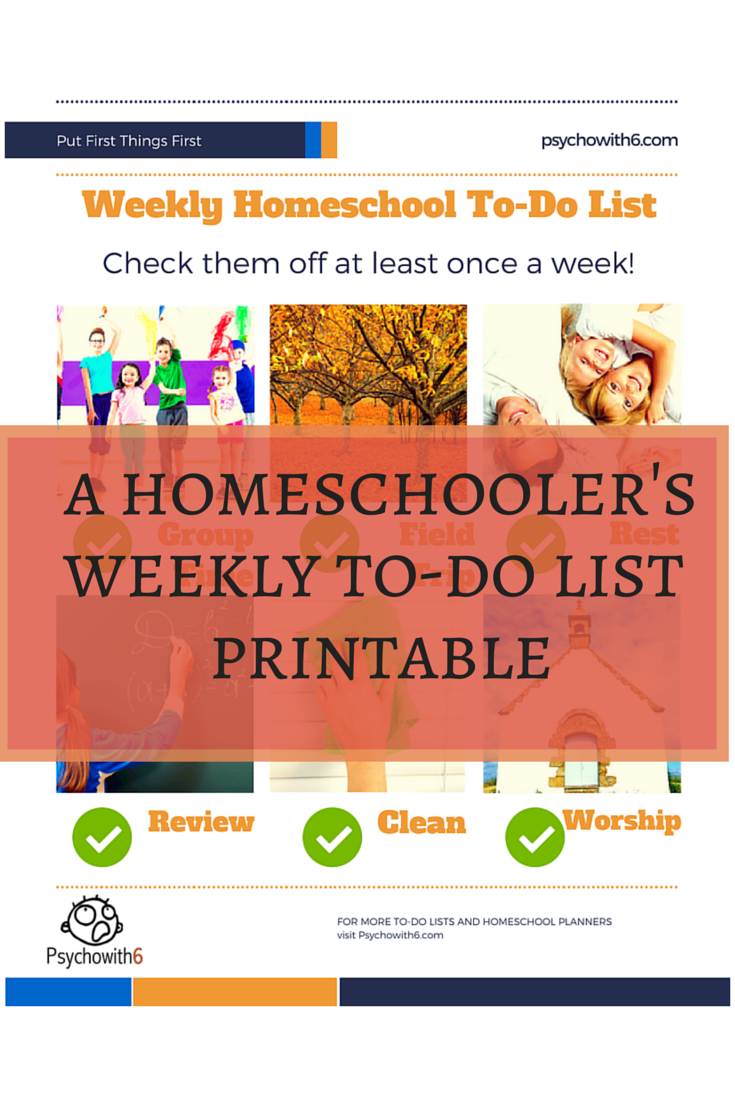
I shared a daily to-do list for homeschoolers, but that doesn’t cover everything we should be doing, does it? This weekly list is a great goal for six other tasks. If you’d like a free printable copy, click the orange button below to subscribe to Psychowith6 and you’ll receive it in your inbox lickety split! Current subscribers can find it in the folder linked at the bottom of your Psychowith6 email. Click Here to Get the FREE Printable
Add your printable to your homeschool binder in a page protector, laminate it, or frame it and you can use it every week with a dry erase marker. It’s a great reminder for me and I hope it is for you! Note that this is a PDF as pictured above and is not editable. If you want a to-do list that you can create yourself, check out the Homeschool Record Form or the Quarterly Checklist.
#1 Group Time
I admit that I once thought homeschoolers couldn’t possibly get enough social time. How wrong I was. But it’s a vital part of our homeschool to get together with other homeschoolers for co-ops and classes. We’ve also enjoyed having the kids participate in other sports and activities that aren’t just for homeschoolers. I don’t have to worry about forgetting this task. My kids insist upon group time!
#2 Field Trip
While we don’t go on a formal field trip every week, I do aspire to regularly take the kids out where they can learn and explore. Nature walks, parks, museums, and even the grocery store can work. Ask questions of the different workers you come into contact with. We’ve learned so much from just doing that!
#3 Rest
Some of you laughed when you read my suggestions of group time and field trips, because all you do is go, go, go! But homeschoolers need a day of rest, too. Sunday is our day, but we all have different schedules. Allowing everyone to relax and do what interests them with no schedule is so important physically, emotionally, and spiritually.
#4 Review
I believe it’s so important to review what we’ve learned–not through formal testing–but by discussing it and answering verbal questions, especially when kids are younger. I haven’t done a great job with this and that’s a shame, because review reminds mom how much she has actually accomplished and helps move information into long-term memory. Every day, write a couple of questions on notecards based on what you’ve learned and play a little Jeopardy game at the end of the week. It could be everyone’s favorite time. That’s my goal.
#5 Clean
If we didn’t clean up twice a day, our house would be condemned in no time. But we still need time for more time-consuming tasks like dusting, vacuuming, and laundry. Build time for this more concentrated cleaning into your school schedule so you won’t be stressed. I assign various tasks based on the kids’ ages. We have been doing a little of these throughout the week for years, but we are going to try to knock these chores out on one day. We’ll see how it goes.
#6 Worship
We see our worship as part of our homeschool. We all learn something in Bible class and from sermons, even though we study in depth as part of our studies. Church is something we don’t want to miss! But when illness strikes, my husband will often read and discuss the Bible with us. I have some Bible study DVDs that I would love for us to watch together as well. We haven’t made the time for them, so that’s a goal, too.
Most of the interpersonal problems I have seen professionally and personally could have been avoided with good communication. This week we will focus on improving our parenting communication skills. Here’s how:
#1 Have the kids evaluate you
We are going to start with a task that most parents never do: ask their children to tell them how they’re doing. We may imagine that having our children evaluate us encourages them to be disrespectful. On the contrary, this kind of open communication promotes respect. Children who feel they have no voice in their relationship with you are most likely to rebel.
We may also fear hearing about our flaws. Yet, it’s better to be told now than to hear when our children are adults that they were unhappy with our parenting or teaching. With our humility comes the opportunity for God to change us and our families for the better.
I have created a form that your children can use to evaluate both parents. It may not be appropriate for younger students. Make sure your children know that you want their honest opinions and that you won’t be angry or sad if they give them.
It seems like an oxymoron, but parent-teacher conferences are very important for married homeschooling families. We can be so busy that we don’t make time to discuss each of our children’s academic and personal progress as a couple. A child may continue to struggle unnecessarily because one parent isn’t aware of the need. When we don’t know what to do, our spouse may.
Schedule a time with your spouse for conferences (you may have to schedule one child at a time) and then complete these Homeschool Conference Evaluation Forms from FiveJs.com. The forms provide an opportunity for the primary teacher to evaluate students and for the students to evaluate themselves.
Using these forms and the parent evaluation forms, prayerfully discuss each child. Agree on when to meet with your child, what you want to praise each child for, and what you’d like the child to work on. Use this time to pray together about a personal goal in your parenting for the rest of the school year as well. Ask your spouse to help hold you accountable with regular progress updates.
#3 Have a conference with each child
When both parents meet with a child, he learns that he is valued. You could meet with him at home or take him somewhere special where you will have the opportunity to talk. Keep your conversation positive. Affirm your love for him and your confidence that he can keep growing. You may wish to present your child with a Scripture that you believe will help him understand your heart for him.
#4 Plan special time for each child
You don’t want to a conference to be the only special time you have with each child. Parents of many children will find daily time with individual kids a challenge. Doorposts sells a Family Time Circle that will help you remember who’s supposed to spend time with whom. Some families like to be less structured with individual time and choose to take the opportunities that present themselves (i.e., take one child to the grocery store, another on a different errand, and so on).
Come Together Kids shares a very clever idea for planning monthly special time. Although the idea is used as a valentine’s gift, these scratch-off cards would be well-received any time.
Which of these tasks do you think will give you more confidence as a parent?
I’m a Christian psychologist turned homeschooling mother of six. My life can be a little crazy, so I look for sanity-saving ideas to use and share. I hope you’ll read my About page to learn more.