Our family has been watching America’s Got Talent for the first time this season and it’s been enjoyable. But I think the most valuable aspect of watching for me is what it’s taught me about personal productivity. Whether you’ve seen the show or not, you may appreciate what you can learn from it, too.
#1 It’s okay to let a lot of tasks audition for your attention
The AGT season begins with auditions in front of the judges and a live audience for acts that have made it through the city auditions. The judges approve a high percentage of these acts; they all seem great! What’s remarkable (and sometimes wearying) is how many acts are allowed to audition.
This first round is like our task inbox. The majority of the potential tasks, projects, and opportunities presented to us should go into our inbox so we can consider them again. While the number of possibilities can be tiring, I like to keep my inbox open to them. A point of clarification: urgent tasks wouldn’t be put in the inbox (AGT is an entertainment venue, not an urgent care clinic).
#2 Give tasks a second critical audition
There are a small number of acts (eight this year) that are allowed to audition at Radio City Music Hall without a second audition, but there are none that aren’t given a second consideration. These eight fortunate acts were discussed by the judges and were given a free pass where Judgment Week was concerned. All the rest auditioned for the judges, and only the judges, again. There is something about the second look that makes the judges wonder what they were thinking when they put them through in the first place. Removed from the emotion of the crowd, the judges are able to discern which acts are most likely to achieve their goal of discovering a million-dollar act. A sizable portion of the acts are dismissed at this point.
With fresh eyes, we will also recognize immediately when an “act” in our inbox needs to end its journey with us. Time to allow emotion to cool and a quiet space can likewise help us determine if an item is a clear winner because it will help us reach our goals. I prefer to pass judgment on my tasks in the quiet of my family room the next morning.
#3 Limit the number of tasks in each genre
AGT is seeking a variety of acts for its finalists. They wouldn’t want 20 singers and 4 dance acts, because it wouldn’t be as exciting as a few singers, a few dancers, a few comedians, and a few magicians.
Variety is the goal for most of us, too. We all have life areas that are our genres. Some of mine include homeschooling, blogging, writing, relationships, and church. Blogging is an area I tend to have too many “acts” in. I have to eliminate some of them so I have more great relationship acts in my life. I can easily see how many tasks of each genre I have by assigning them a category. I do this in ToDoist, but nearly any application or paper list will work. I’m happier and healthier when I have balance.
#4 Get input from another audition
At Radio City Music Hall, each act once again has the benefit of a live audience, but is now judged by America. More than half of the acts are eliminated by this vote.
It’s easy to add tasks to a list and neatly categorize them, but that won’t mean they’ll go any further. We need to review them again and get input to trim the list . It would be interesting for me to have my readers vote each week on which tasks I should do, but not very practical. However, I can get valuable input during my weekly review. My husband’s vote carries great weight with me, because he not only cares about my life balance, but about my goals. Looking over my upcoming commitments is also a vote for certain tasks over others. The calendar can dictate which tasks go on. Finally, I consider past results to help me differentiate the winners. For example, when considering a long list of potential blog post topics, I review Google analytics for my most popular posts to decide which ideas will go forward.
#5 Choose a small number of finalists after yet another audition
AGT will continue having auditions and votes and judge input until a small pool of finalists is chosen. With time, more opportunities to see the acts, and a limited number of finalist spots, choosing often seems easier.
My week seems to have plenty of time, but my days–not so much. I plan my day each morning and often decide that the task I added to DayMap for the day isn’t going through. Like the AGT judges, I would love to keep so many of these options, but there isn’t room for them all in my life. I limit tasks using a scheduling app that I will tell you about soon. The winners are the tasks I actually do, with most of them hopefully helping me reach my goals.
#6 Let tasks audition again in the future
A number of acts that make it through in AGT were cut in previous seasons. Either the time wasn’t right, the act wasn’t, or the judging was different.
Cutting tasks from our list doesn’t mean they’ll never be winners. That’s what a Someday/Maybe list is for. I keep the tasks that didn’t make it in Evernote. There are too many of them to review every week, but I can easily add a tickler date to them so they can audition for my attention again.
Consider which of these lessons has the most potential to increase your productivity and put it into practice this week. Let me know how it goes!
While a traditional list can remind you of what to do, daily reflection can help you determine if you’re doing the right things. At the end of the day, you may have everything crossed off your list, but you are left with this nagging feeling that you let someone down. Maybe that someone was you.
Or regardless of how much you accomplished, you’re worried about tomorrow. A traditional to-do list can’t help you there.
I don’t want to go mindlessly through my days, checking off tasks. I want to stop and think about what I’m doing and why. I’ve found both a digital and an analog tool for reflection that I recommend.
Note: If you are a follower of this blog and wonder where I’ve been, read to the end for an update.
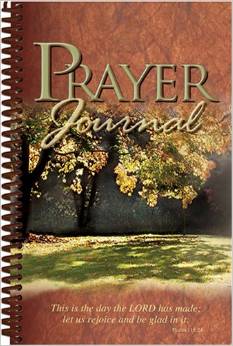
Prayer Journal
I was given this little prayer journal as a speaker thank-you gift. You can imagine I have a lot of these kinds of things hanging around. But I was blown away by the power of this simple journal.
I use mine at night and answer the following questions:
How did I experience God today?
What worries do I need to turn over to God?
Thank you God for…
There is a space for a written prayer to God and then a later reflection on that prayer. There are also Scriptures for reflection.
Why I’m Crazy About It
Every day I’m directed to think about how God spoke to me. As a Christian, that is how I determine if I am doing the right things. I’m surprised every time that I haven’t thought about it, until reflecting on the question.
Turning over my worries to God each evening preserves my sleep and saves me time I can devote to doing the right things.
It trains me to pray about everything.
The 5 Minute Journal
I needed another journaling app like I needed another hobby, but I read about it in a Chandler Bolt email and he was really enthusiastic. I had to see what he was so excited about. The iOS app reminded me to journal without me having to set up reminders. Like the Prayer Journal, 5 Minute Journal asks what you’re grateful for, but is proactive in the morning, asking what would make today great. I’m also asked for a daily affirmation (a little positive labeling is good to counteract all the negative).
In the evening, I’m asked for 3 amazing things that happened today and how I could have made today better. It has the capability of adding a photo, but since I already use Project Life to document my year, I don’t use that aspect of the app.
Why I’m Crazy About It
I love being reminded to reflect by my phone. When I get the reminder, I’m excited to answer the questions.
The questions put me in a good mood. All of them have a positive focus.
I like to see if I end up doing what I thought would make today great. You aren’t looking at what you wrote when you answer the question. You will eventually see some patterns.
Don’t have an iOS device? The 5 Minute Journal has been published in book form, too.
What tools do you use for daily reflection?
Update
A productivity pal recently asked me, “What happened to you?” Fair question! It’s been six months since I’ve blogged regularly about productivity. I’ll give you the answer in bullet form (you know, to save time).
I’ve been spending most of my writing time creating elementary curriculum. Productivity posts have taken a back seat.
I didn’t feel I had the right to blog about productivity until my A Year of Living Productively ebook was done. I’ve since determined that this makes no sense.
I got stuck writing the ebook because I thought I had to say something new. Since there is nothing new under the sun, I had a dilemma. My current plan for the book is to organize my blog posts for easy readability with an update on how the various productivity hacks are working for me now. The goal is to have the book ready on Amazon by the end of the year. It will be free!
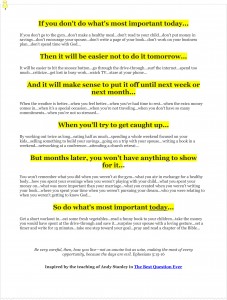
If you don’t go to the gym…don’t make a healthy meal…don’t read to your child…don’t put money in savings…don’t encourage your spouse…don’t write a page of your book…don’t work on your business plan…don’t spend time with God…
Then it will be easier not to do it tomorrow…
It will be easier to hit the snooze button…go through the drive-through…surf the internet…spend too much…criticize…get lost in busy work…watch TV…stare at your phone…
And it will make sense to put it off until next week or next month…
When the weather is better…when you feel better…when you’ve had time to rest…when the extra money comes in…when it’s a special occasion…when you’re not traveling…when you don’t have so many commitments…when you’re not so stressed…
When you’ll try to get caught up…
By working out twice as long…eating half as much…spending a weekend focused on your kids…selling something to build your savings…going on a trip with your spouse…writing a book in a weekend…networking at a conference…attending a church retreat…
But months later, you won’t have anything to show for it…
You won’t remember what you did when you weren’t at the gym…what you ate in exchange for a healthy body…how you spent your evenings when you weren’t playing with your child…what you spent your money on…what was more important than your marriage…what you created when you weren’t writing your book…where you spent your time when you weren’t achieving your dream…who you were talking to when you weren’t getting to know God…
So do what’s most important today…
Get a short workout in…eat some fresh vegetables…read a funny book to your children…take the money you would have spent at the drive-through and save it…surprise your spouse with a loving gesture…set a timer and write for 15 minutes…take one small step toward your goal…pray and read a chapter of the Bible…
Be very careful, then, how you live—not as unwise but as wise, making the most of every opportunity, because the days are evil. Ephesians 5:15-16
I will warn you that I am not the productivity queen Francis makes me out to be in his post and in the podcast interview he did with me. But he is a very engaging writer and podcaster! Among the things he wanted to know were what worked and what didn’t in this year-long process. I hope something I share will inspire you to find what works for you.
This is a guest post by Tim Sprosen from the UK who is a medical researcher at the University of Oxford, a husband and father and writes about his productivity journey at www.timsprosen.com. In this post, Tim returns to the wisdom of Covey’s 7-habits to remind us all that being productive is not just about getting things done.
Stephen Covey’s 7-Habits of Highly Effective People was first published 25 years ago and I can still recall the day when I picked it up from a newsstand at Chicago’s O’Hare airport before catching a flight back home to London. This book had a profound impact on my approach to time management. As well as providing a practical framework for personal organization, where Covey clearly identified the next seven days as being the ideal period of time to plan and organize – the genesis of the weekly review – the book also recommended taking a very top-down approach to organization.
What that means is working out first and writing down what is important to you before dealing with the day-to-day tasks and other demands on your time. Unfortunately, as I recently pointed out, so much discussion of productivity today and, in particular, the false hopes of technology – what I call the app-trap – is entirely focused on task management. It is like we are relentlessly trying to run a little bit faster without first stopping to work out where we are heading (and also who we are heading there with – keep reading…).
But, what I think was really ground breaking about the book, particularly at a time when so much of the “success” literature was only concerned with money and material things, was the focus on building character and being more concerned with people rather than things. In practical terms, this meant drawing up a mission statement that included identifying the key roles in your life and then on a weekly basis reviewing each of these roles and setting the key things you want to achieve in that role for the coming week. While I am no fan of the concept of work-life balance, organizing your week around your key roles really helps to bring actual balance to life.
Let me give an example. Let’s say the coming week I am traveling with work and will be away from home. Looking at my role as a husband and a father, I might set goals in those roles to book a table to have dinner with my wife when I return home and in the role of father I might make a note to pick up a gift for each of my children while I am away. Then when I look at my role of son this reminds me to make a note to call my mum before I go away. This simple list of my key roles, which I look at each week, really serves me well and like any productivity tip, it means I don’t need to worry about trying to keep these reminders in my head.
So, for the week ahead, try looking at the things you want to get done not just in terms of your tasks and goals, but also through your key roles. Why I invest time in my personal productivity is very simple; it is to spend more of my time and energy on those people and things that matter most to me.
[Melanie here. I couldn’t agree with Tim more and his post was very timely for me. Was it for you?]
I don’t know any homeschoolers who don’t have a lot to do.
Cooking, housekeeping, kids’ activities, church and homeschool group responsibilities, and outside work on top of parenting and teaching can keep you really, really busy.
No matter what your situation, you have a lot of tasks to manage–possibly more than you’ve had at any time in your life. If you haven’t found a way of managing your workload efficiently, your tasks may get in the way of your homeschooling.
This week we will focus on managing our to-do’s so they don’t manage us.
Want to watch this challenge on video instead? Scroll to the bottom.
Your Challenge for This Week
#1 Discuss task approaches and choose one to try
All work is managed with a to-do list, whether that list is in your head, on your calendar, or in a fancy app. But just as with curriculum, there are many, many kinds of to-do lists for many different kinds of homeschoolers.
Older children can (and probably should) be included in a discussion of managing tasks. They will be managing to-do’s on their own soon and teaching them how is a wonderful life skill. However, they may want to use a different approach than mom or dad because they have different personalities and workloads. The best approach to try is one that isn’t wildly different than what you’re doing now.
#2 Acquire the materials you need and set them up.
If you’re going to use a notebook and a pen or your calendar, you’re good to go. But if you want a new planner or an app, for example, you’ll need to get them and prep them for use. If you are going to use forms you download, you’ll need to print, copy, and probably 3-hole punch them.
Think about how you will use your approach when you’re away from home. Do you need a small notebook / datebook for your purse? Should you download an app for your phone? How will you make sure that tasks don’t fall through the cracks?
#3 Add a small number of tasks to your list and work on them.
Getting Things Done emphasizes the importance of adding absolutely everything you need or want to do to your list and later deciding that some of the tasks are someday/maybe tasks. Most homeschoolers could come up with thousands of tasks in no time, quickly producing overwhelm.
Whatever approach or list type you use, I recommend against adding every conceivable thing to your list right now. First, look at the upcoming quarter. Is there anything you need to start working on now? Second, look at the upcoming month. If you need to get started on something that is due in the next 30 days, add it to your list. At this point, don’t add things that you’d just like to do, but actually need to. You can add the want-to’s to your list as you find your managing your must-do’s. Third, add tasks that you have to complete this week. Finally, add things you need to get done today.
This may be the one list you work from every day or it may be the main list that you use to create a short list of tasks you want to accomplish today. Remember, that if you have a routine, you don’t have to add regular occurring tasks to your list.
#4 Continue working on your tasks and discuss your likes and dislikes.
I really enjoy buying planners, apps, and pens as well as spending time setting up new systems. That’s why I wrote a year-long series on living productively. But the point of this week’s challenge is to get more of your tasks done, so we have to get busy! Keep working on managing your to-do’s and take time to regularly discuss what’s working and what’s not.
I would love to hear about what you’re trying and whether it’s working for you. Discussing the pros and cons of your task management approach helps you remember that you’re not failing. You just need to keep working out a way to get things done that works for you–even if that means having to change it up frequently so you don’t get bored.
I’m a Christian psychologist turned homeschooling mother of six. My life can be a little crazy, so I look for sanity-saving ideas to use and share. I hope you’ll read my About page to learn more.