This is the time of year when we homeschoolers consider what worked and what didn’t in our homeschools. We want to plan to have the best homeschool year possible. There are three simple strategies for homeschool planning.
The first step isn’t purchasing a new planner or learning a new program. Instead, it is to ask yourself why and why not. First, consider your best homeschool day. By that I mean to choose a typical homeschool day that went really, really well. Envision it as clearly as you can and then try to determine what it was that made it so good. Was it scheduled? Did everyone go to bed on time the night before? Did you exercise before you started your day? Did you do devotions first thing? What were your children’s attitudes? What material were you studying? How were you learning it? Were you working as a family? Were you doing individual tutoring? Were you going with the flow and learning as you felt led? Perhaps you included a field trip or spent some time outside.
Our natural tendency when something out of the ordinary goes well is to think that we can’t do it on a regular basis. Allow me to explain. If you had an amazing homeschool day because your children begged you to keep reading a book they love and you did it, you may think that doing this on a regular basis isn’t realistic. If you took an unschooling approach to the day, you may think that you cannot meet your homeschool goals that way. Or perhaps you relaxed the rules and ended up having a great day. Ask yourself why not. Why can’t you continue to do the things that work? I find it helpful to actually say ‘why not’ out loud. Perhaps your answer is someone wouldn’t approve. Whose approval do you need to homeschool your children in a way that works? Perhaps you have very real regulations that you have to abide by. Is there a way that you could continue to have great homeschool days and still meet those rules? I encourage you to ask a veteran homeschooler who knows you and knows the laws of your state about your homeschooling practices. Ask how you can continue to have more great homeschool days.
In the same way, consider one of your worst homeschool days. Really picture it in your mind. What was it that led to this disastrous day? Did you have cranky kids because they hadn’t gotten enough sleep? Were you cranky for the same reason? Were you pushing your children to do something because you were worried about what someone else was going to think? Did you continue to insist that your child complete a certain curriculum or use a certain approach that ended badly? If you aren’t sure what led to that no good, very bad day, ask your children if they can remember. Our children are often very good at being able to tell us what isn’t working. We just have to be willing to listen.
After you have considered all of the aspects of the day that led to its demise, ask yourself if you have to do things the same way in the future. If you believe that you have to keep using the same curriculum or completing the same classes or keeping the same schedule, ask yourself why do I have to? Whose expectation are you trying to meet? Is it truly a rule that you must keep? Are there activities that you absolutely must engage in, or are there activities that you could let go of in this season? By asking ourselves why not when it comes to activities that work and why for activities that don’t work, we can come up with an excellent homeschool plan. The truth is there are many homeschoolers who would not approve of how I homeschool my children. But I no longer care! Homeschooling the way that we do it works for us. And with God’s blessing and obedience to the law of my state, I don’t have anything to apologize for.
Establish routines that work
The second step to take when planning your homeschool year is to establish routines that work. Most likely the homeschool day that was ideal for you involved healthy routines. You got enough sleep, you didn’t have a meal at 10 o’clock at night, and you felt in control. The best way to realize the goals that you have for your homeschool this year is to establish routines. I had FLYLady (a.k.a. Marla Cilley) on my podcast talking about the power of routines. The lack of routine is what threatened to destroy my homeschooling when I had barely begun. No one had ever told me about the power of unloading the dishwasher at the same time every day, the power of insisting children do chores every morning, or the power of having a consistent bedtime. All of those things and more made homeschooling possible for me and even made having more children possible.
A routine change you should consider, if you haven’t already, is doing family school time together in the morning. I have done this for years. Some of our family time activities include prayer, Bible time, history, vocabulary, and read alouds. The content has varied over the years, but the routine of beginning our school day together has been a part of o our ideal homeschool days for years. When we are finished, my kids do individual work and I can help with individual subjects.
A second routine change to consider is cleaning up after every subject. When your schoolroom and your home are in order, you feel better about what you’re doing. FLYLady discussed this in a podcast episode on getting organized.
A third routine to add is scheduling time for the weekly organizing challenge of the week from The Organized Homeschool Life. Last year I tried to do my organizing challenge during our regular chore time. I usually got so into the challenge that I wasn’t supervising the kids’ chores. Let me tell you, the kids need supervising! This year I will be spending an hour per challenge on Saturdays.
Plan the quarter
The final step in planning your homeschool year is to plan the quarter. What we often try to do in our perfectionism and desire for control is plan the entire year. I’ve spoken before about the recipe for frustration this is. Listen to the podcast episode I did with the creators of A Plan in Place planners for more on that. I have also spoken before about how motivating it is for my children to have a short list of assignments to complete before they can earn a break. Planning quarterly has allowed me to give my children that motivation all school year. I created a quarterly homeschool planner that you can find in the show notes. I recently began using Trello to plan my children’s quarter. I created a Periscope broadcast where I showed how I set it up. Things change so often. Kids get sick, the unexpected comes up, and planning an entire year is not wise.
With a new homeschool plan, 2017 can be a very blessed year. What’s on your new homeschool plan? Let’s chat about it on Facebook.
Homeschoolers have to consult a number of different professionals. For example, I am often asked about having children tested for special needs. Another area I am often asked about is seeing a mental health professional. This could be seeking services for yourself, your marriage, or your children. Finally, we may need to consult professionals for our own or our children’s physical needs.
Why is this even an issue? Because as homeschoolers, we tend to lack trust for those who are outside of homeschooling circles. And this is understandable! We are DIYers. We like to do things ourselves and it can be hard to trust those who may not have a favorable view of homeschooling. However, there are times when not seeking professional help is hurting us or hurting our children. In fact, there are instances when failing to seek professional help could be considered neglect. There is no way I can tell you if you’re in that situation. But I can ask you to prayerfully consider whether it is time to seek professional help. One indicator that it is time is that you are you or your child is having difficulty functioning in daily life.
I wish I did not have to mention this as a reason you may be reluctant to seek professional help, but I feel I have to. If we feel that we have something to hide, we may not want to see a professional who could determine that we are not providing the best education for our children. If you are suffering from clinical depression or severe anxiety to the extent that you are not able to educate your children and this is a chronic condition, not a temporary one, I ask you to consider having your children educated in another way for now. Whether that means asking a friend or family member to help, or putting your children in a traditional school, I ask you to do what is best for your children. If people you trust are telling you that need to stop homeschooling, listen to them. Just because homeschooling isn’t the best choice now does not mean that you will never be able to homeschool again.
How to Work with Professionals as a Homeschooler
If the difficulties that you or your children are having do not threaten your ability to adequately educate your children, then I recommend the following six steps.
Get a referral. My favorite way to have people get referrals for professional services is through their local homeschooling support group. If you are part of an online forum, this is an ideal place to ask for the professional you need. Another place to ask, depending on the type of professional you need, is your church. Most pastors are aware of Christian counselors that they can recommend to you. Finally you may have friends who are in the medical or mental health field who can give you a good referral for a professional in your area.
Become a member of HSLDA. This is especially important if there is any reason to believe that you could go through a divorce in the future. More than just practical assistance, a membership to HSLDA provides you with peace of mind. If you should have contact with a professional who is anti-homeschooling and chooses to make an issue of it, you will know that you have good attorneys in your corner.
Pray for favor. It may be the case that you do not have a Christian professional who is pro-homeschooling that you can work with. That does not mean we should be fearful. Nehemiah prayed that he would have favor with an unbelieving king (Nehemiah 1:11) and he did. Pray that the professional you are seeing will be open and supportive to providing the help and services that you or your child needs.
Don’t tell the professional that you’re homeschooling if that information is unnecessary. There are certainly occasions, such as working with a reading specialist, where it’s obvious that you have to say that you’re homeschooling. But if you are seeing a general practitioner for depression and you are interested in taking an antidepressant, for example, there is no need for you to talk about the fact that you are homeschooling, especially if it’s not relevant. If it is necessary to talk about the fact that you are homeschooling, be prepared to educate the professional about homeschooling. Many people still aren’t aware of the facts of homeschooling or they have unfortunately believed some stereotypes about homeschoolers. For example, they may believe homeschoolers isolate their children so they have a better opportunity to abuse them. Because that is a potential issue, make sure you talk with the professional about the activities that you and your children are involved in. Do not be defensive, but be open and positive in response to their questions about it. You may have had some concerns about homeschooling in the beginning too. I know I did. Of course, I was worried about socialization!
Be open to advice. If you have prayed about your consultation with a professional, be willing to listen to what that professional has to say. Of course, this does not mean that you have to accept the advice, but do try to listen to another perspective. You may be given insights that you would not have had on your own. An example of this in my life was when one of my sons was struggling to read phonetically. Using phonics to read is the approach most accepted in homeschooling circles. But I spoke to my neighbor who is a reading specialist, and she told me that I needed to let my son use a whole language approach to read. If you have no idea what whole language is, that’s understandable. It essentially means that you allow your child to memorize words in whole. As soon as I allowed my son to stop sounding out words and to just memorize them, he was reading and feeling confident about his ability to read. Be open to advice you get from professionals. Research it and discuss it with your spouse and others.
Do not be confrontational. The final step I have for you in working with professionals as a homeschooler is one you need to take when your views of the problem and the professional’s view of the problem are in conflict. The Bible tells us to be kind to everyone and able to teach (2 Timothy 2:24). We cannot be kind or teach professionals about the homeschooling lifestyle and the advantages of it, if we are belligerent. If a professional makes a suggestion, such as you need to put your children in school, simply say, “Thank you for the advice. I will consider it.” Then it is well within your rights to move on to a different professional for a second opinion. I would not announce the fact that you are going to seek a second opinion, however. In every way we want to present ourselves as reasonable, open, and concerned with what’s best for our children. If you find that the professional you have consulted is not a good fit, start the process over again. Get another referral, pray for favor, and be open to advice. Sometimes finding the right person to work with can be as challenging as finding the right mate. Be patient and don’t give up.
What experiences have you had working with professionals as a homeschooler? Do you have any other advice? Let’s chat about it on Facebook.
I spent a year doing weekly experiments in productivity. The benefit of the series is that I learned the most important habits for getting more done. My hope is that reviewing what works for me might give you some insights into what could work for you. I hope you’ll listen to an interview I did with Barb Raveling of the Christian Habits podcast on the subject. Barb wanted specific advice for a time-management hiccup that plagues many of us. I’d love to know if you have different advice.
#1 Plan your week
David Allen’s Getting Things Done was my first foray into productivity literature. I loved it and should have been a paid seminar leader for as many people as I told about it. GTD was the impetus behind me finally getting my email under control and collecting all my to-do’s into one trusted system. I had these habits prior to experimenting. The GTD habit I didn’t have was a weekly review.
I became overwhelmed by the process of reviewing all potential to-do’s each week as part of the GTD process and so I just didn’t do it. Unfortunately, that meant that I wasn’t reviewing my calendar or projects for the upcoming week. I was often finding myself surprised that I couldn’t get to a number of tasks I planned because I had forgotten about prior commitments.
Using a paper planner during my experiments convinced me weekly planning was important. Now I have the habit of planning my week each Sunday. I actually look forward to it! I review my calendar, projects, and life areas in ToDoist, and even Pinterest ideas that are sorted into corresponding secret boards. Rather than overwhelming me, a weekly planning session (or review) helps me feel in control. I can set weekly goals and make sure that the tasks I can reasonably accomplish in the upcoming week are visible. The rest are put aside. I no longer have calendar surprises! For more on my weekly planning process, read this post.
If you aren’t getting much accomplished in a given week, try a weekly planning session. Just 30 minutes of planning will be a wonderful investment in your productivity.
#2 Schedule your day
Before my year of productivity, I wasn’t really wild about scheduling my days. It felt too restrictive for this spontaneous, time-rebel woman. I did love my week of using SmartDay, an iOS app that automatically places to-do’s around scheduled activities. But my passion for the habit of scheduling my days didn’t reach its peak until after the series was over.
The first thing that convinced me of the value of scheduling was Francis Wade’s post that has been hugely popular on this blog. I thought I needed to revisit the idea and I did begin using SmartDay more frequently. But it wasn’t until I read this article about how the president’s day is scheduled that I realized that I needed that kind of productivity. While I don’t have an assistant who schedules for me, I am that assistant.
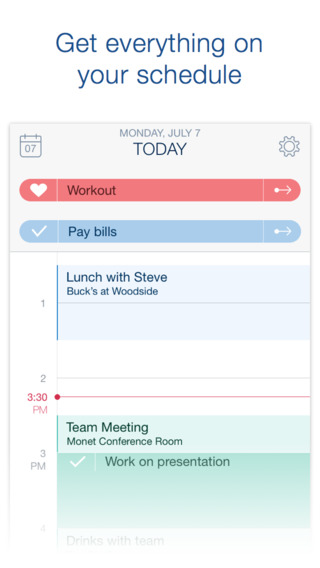
About the time that I read this article, I heard about an iOS scheduling app very similar to SmartDay called Timeful. I love it! Each morning I put together the day’s agenda based on my weekly plan. When each new activity is supposed to start, Timeful plays a pleasant tone on my phone. Unlike a paper schedule, Timeful makes it easy to move things around and change the amount of time I plan to devote to them. Timeful reigns me in when I start off thinking I can easily finish 101 tasks in a day; they just won’t fit in the calendar! If I want to leave times open in my schedule, Timeful makes suggestions and learns from my behavior when I am most likely to want to do tasks. The bonus is Timeful can be used to schedule goals as well. I don’t think I’ve ever completed the schedule as written, but here’s why this doesn’t discourage me: I accomplish more in half a day that’s been scheduled than I do in an entire day just working from a to-do list. I created a Timeful calendar in GCal and now also have a record of how I’ve spent my time.
If you need to get more done, try scheduling your day. Even old-fashioned paper will work!
#3 Build energy-based routines
Routines differ from schedules in that they are tasks you repeat daily or weekly and don’t need to be put on your to-do list. I relied on routines before starting my year of productivity, but I kept trying to force myself into idealistic routines that just didn’t work for me. For example, I tried to get myself to do homeschooling subjects with the kids (that I don’t enjoy doing) in the afternoon. Once afternoon comes, I have very little energy left to overcome resistance. I learned that putting those subjects early in the day, when I’m most energized, made all the difference. I saved the subjects I loved to teach for the afternoon.
Similarly, I learned that trying to get myself to do high-energy tasks in the evening was a waste of time–no matter how ideal it would be. Evenings are now saved for social media, schlepping kids to activities (when I can’t talk my husband into doing it), and family fun. That understanding enabled me to stop being so mad at myself for “not getting anything done” in the evenings.
But I was left with a dilemma. I am writing a homeschool curriculum–a major undertaking. I kept trying to find a time to work on it in my daily schedule. Morning was an obvious choice, but it wasn’t working for me at all. I can find morning time to exercise, do devotions, and chat with my husband, but not for writing. I tried getting up even earlier during the course of my year of productivity and found I was crashing mid-morning. I’ve already made it clear that I’m worthless most evenings, but I thought I would just have to force myself to write at night. You can imagine how that went. I realized that the ideal time for me to write was early afternoon. Yes, I just said that I didn’t like to teach aversive subjects in the afternoon, but that’s teaching after a full morning. I have always longed to write in the afternoon, but felt guilty about it. After reviewing other homeschooling mothers’ schedules (who have many children and blog, too), I realized I was not only spending more time doing hands-on teaching than they were, but than most public school teachers! I reevaluated my teaching schedule, made some changes to encourage more independent learning, and started writing in the afternoons. I have written every single day since making the change and feel energized while doing so!
If you are struggling to get things done, build a routine around your energy levels. Keep experimenting until you find the right combination of times and tasks.
#4 Work little and often
It’s a waste of time to try and figure out why you procrastinate on some tasks. Yes, I’m a psychologist and I’m saying that! I have no idea why I hate mailing things so much, but I do. I would rather take a paper and drive it across town. It’s weird. But during my year of living productively, I discovered a solution: just do a little and do it often.
I discovered that I could get things mailed if I counted any tiny step as done for the day. I would find an envelope and re-date the mailing task for the next day when I would put a stamp on it. Yep, it’s ridiculous, but it worked. Before I started practicing little and often, I would have items to be mailed sitting for weeks. Now when I come across a scheduled task that I’m putting off, I will count any little step as done for the day. Fortunately, I don’t have to do this often, but it makes a world of difference to do something. The next day when I’m faced with the same task, it feels less onerous because “I’ve already started it.” Even though Pomodoros were a separate weekly experiment during the year of productivity, they’re effective for the same reason. For a particularly aversive task, I will set the timer for five minutes and call it done.
Do you keep facing the same yucky task day after day? Do five minutes or one tiny step on it and count it done! Repeat tomorrow.
#5 Do it now
My week of doing it now appealed to readers and even my kids who loved this video. I can be doing a great job with my schedule, but if I don’t do the little tasks when they need to be done, I can easily find myself overwhelmed. I’m talking about things like adding things to shopping lists as you see you need them, putting clothes away as you take them off, and cleaning up messes as you make them. David Allen recommends doing tasks that took less then two minutes. I think that’s a fine rule, but even better is to do tasks now if now is the best time to do them. We will not have more time later!
Some quick tasks are better batched. Paying bills is a good example. I pay bills online on Mondays. Even though it would take me just a minute to pay a bill I receive on a Tuesday, I don’t. But if I spill a box of cereal, I’ll clean it up now. I won’t wait until kitchen clean up day. Does this seem obvious? I become an imbecile when it comes to these things.
If tasks are starting to pile up, do them now if now is the best time to do them.
#6 Ask for help
I have my kids do chores and my husband is a big help, but I rarely ask for help in other ways. During my weekly experiment, I learned how important delegating can be to get more done. But in the months since my experimenting, I have learned that asking for help can be an even more powerful way of accomplishing things.
Because I didn’t have the ask-for-help habit, I wasted a lot of time doing things myself or doing them the hard way. I recently found another example of how my behavior hurt my productivity. I had been wishing for an iOS app that would enable me to process my to-do’s. I had to wait to use the desktop to get them into ToDoist. I also wished that there were an iPhone app that would allow me to attach photos or files to email automatically. Mike Vardy mentioned Dispatch in the ToDoist Google+ group. Turns out, it does everything I need it to do. I could have been enjoying the faster email processing if I had only asked if there were apps that did what I needed. It’s a hard habit to break, but I’m trying to ask people for help more often.
I’ve also learned to ask for help from God. I have always been willing to ask God for help for medical and relationship and even emotional issues. But not to-do’s. When it came to tasks, deep down I felt that I had no business asking God for help. I just needed to work harder, stop procrastinating, and stop watching cat videos. If I asked for help, that’s what He would say anyway, isn’t it? It turns out that God is much less of a task master than I am. Even when I waste time, God wants to help me. He doesn’t want me to be a self-reliant Christian, but to get to know how good He really is. He has canceled appointments when I’m overbooked, left the stoplights on green, and even given me a close parking space when I asked. Asking God for help with all the little to-do’s is a habit I’m in the process of developing. God is in the process of using it to develop me.
If you don’t know what to do first, try going to God! Ask Him for help, even if you’ve been on a cat video marathon.
Which of these habits do you need to develop most? Or is there another habit that helps you get more done?
I will warn you that I am not the productivity queen Francis makes me out to be in his post and in the podcast interview he did with me. But he is a very engaging writer and podcaster! Among the things he wanted to know were what worked and what didn’t in this year-long process. I hope something I share will inspire you to find what works for you.
I had the pleasure of interviewing Joseph Hoffman of Hoffman Academy for the podcast today. I hope you’ll listen to this excellent interview. I called him the Mister Rogers of piano lessons.
First, let me say that I am not an affiliate for Hoffman Academy. I sought Joseph out for an interview because I am so thrilled to have found something that works for my children.
Why I Needed Hoffman Academy’s Free Video Piano Lessons
I am not a trained piano teacher. I can play, but I know very little music theory. I would have had to spend a lot more time, that I didn’t have, learning how to teach.
Lessons are expensive. I have three children ages 8, 10, and 11 whom I want to learn the piano (my oldest three took lessons from a teacher in our home several years ago). The price tag for in-home teaching would be $75 a week. Ouch.
The other curriculum we’ve tried hasn’t worked. Either the video lessons were too hard for the kids or the book lessons were too hard for me to teach. More often than not, I put piano off in lieu of other subjects.
Why I’m Crazy About Hoffman Academy’s Free Video Piano Lessons
I am learning piano. I can read music and play, but watching these lessons with my kids and playing the music provided in the supplemental materials is helping me see how everything fits together. I’m so excited about the next lesson that I no longer put it off.
The format. I had purchased a DVD curriculum in the past that required buying a cheap portable DVD player to use at the piano. It soon broke. I love that these lessons are accessible online via our large TV (we like to watch the lesson together) and also via our iPad at the piano, so we can practice individually. The downloadable material (an optional purchase) was easy for me to copy and put in binders for the kids.
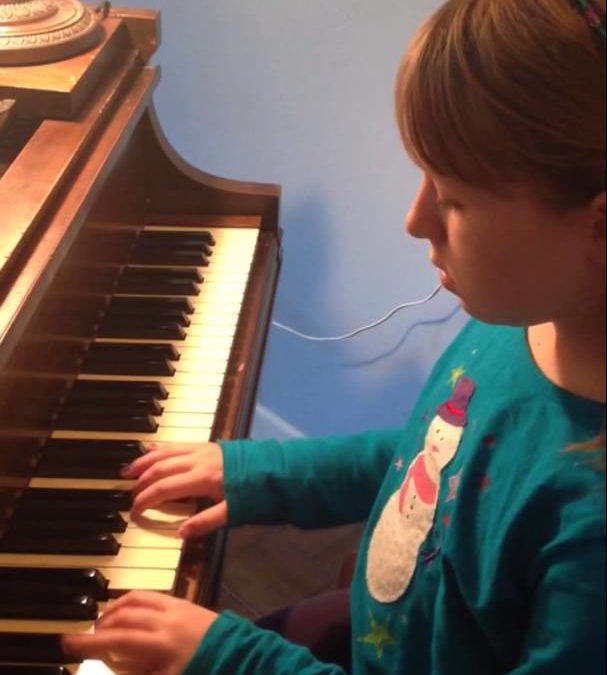
The pace. These lessons are perfect for my busy homeschooling family. Sometimes we just can’t do lessons. I don’t have to call the teacher to cancel. We just pick up where we left off when things calm down. I also love the gentle, Charlotte-Mason-style teaching of Joseph Hoffman. He is so positive and teaches very complex concepts in such a clear and simple way, kids feel confident they can play. That has been very important for my eight-year-old. Here is a video of my daughter playing Lesson 41 (we’ve been using the lessons for a little more than a semester).
The price. I recently purchased the family option for Unit III for $29. For a little more than the price of one traditional lesson, I received the following supplements for 20 free video lessons:
Music Theory Worksheets & Activity Pages (21 PDF pages)
Song Sheets with Practice Instructions (7 PDF pages)
Piano Listening CD MP3s
Practice CD MP3s
Parent’s Guide
I am so pleased with the lessons (that my children actually practice), that I plan to continue as long as Joseph Hoffman continues to produce them! He is offering a copy of the supplementary materials for Unit 1 (the first 20 lessons) to one fortunate reader. I hope you’ll enter the giveaway below, will purchase directly, or will listen to the podcast which should answer many of your questions.
I’m a Christian psychologist turned homeschooling mother of six. My life can be a little crazy, so I look for sanity-saving ideas to use and share. I hope you’ll read my About page to learn more.