How A Daily/Weekly/Monthly To-Do List Saved My Sanity This Week
Kept me from being surprised by important tasks. I don’t have a regular routine of reviewing the upcoming month or week and I absolutely loved this aspect of the system.
Gave me a sense of control. Because I checked every source of tasks (paper inbox, backlog, calendar) before making my lists, I felt on top of my work.
How A Daily/Weekly/Monthly To-Do List Made Me Crazy This Week
Lists were too big. While I really don’t like rules that limit me to an arbitrary number of tasks, I also didn’t like that I was allowed to have a huge weekly list. I think I had half my month’s list on this week’s list. Each day’s list was so large as well that the motivation to complete it just wasn’t there. I never came close to finishing a day’s list or the list for the week.
Closed nature of the lists was confusing. We had a discussion in the comments about what to do with tasks that came up. I suggested that it made sense to replace one of the tasks on the list with a new one. But the list was so big, it really didn’t matter.
I had low energy. Unfortunately, I’m still not brimming with excess energy. I didn’t have it in me to really dive in and do many of the tasks on my list–especially because the lists were large. However, my summer project list continues to motivate me! There’s a lesson in there somewhere that I need to reflect on.
Did A Daily/Weekly/Monthly Help Me Get More Done?
No. But I really like the exercise of planning a week and a month in advance. If I hadn’t attempted to get a year’s worth of work done in a week, I think it would have worked.
**UPDATE**
This is one of the most popular posts in this series and I understand why. I have been just as interested in having a daily/weekly/monthly to-do list. I don’t use this one. I posted on a better daily/weekly/monthly to-do list and my 1-Thing To-Do List is the only list of this type I use consistently.
The Productivity Approach I’ll Be Using for Week 19
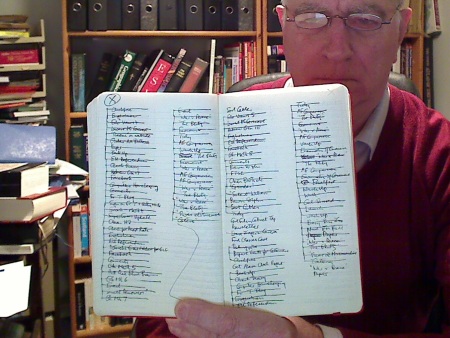
This week I’ll be testing Mark Forster’s Ultimate Time Management System. (I’ll wait while you chuckle.) Mark is developing methods of time management faster than I can test them and I’m running out of pictures to use (this is not this particular approach pictured). I continue to test Mark’s methods because they’re unique and my traffic always goes up when I do. I’ll begin with a closed paper list of OLD tasks to accomplish–what I’d like to complete in the next couple of weeks. Old tasks continue to be worked on and are re-added to the old list until they’re complete. New tasks go on the new paper list. When the old list is finished, the new list becomes the old list. Got it?
The concept. Mark has created rules for task management that create a closed list of old tasks–encouraging us to finish those tasks we least want to do. The new list is used as a break from these tasks. These are the current things that often pull our attention away from the less flashy things. The rule is that wherever you start working on the new list, you can’t work backward. In other words, if you choose task #5, you can go on to task #6 and later, but not #1-4. When you reach the end of the new list (having either worked on tasks or decided you don’t want to do them), you return to working on the old list. This is so you don’t get to stay on the latest and greatest tasks too long.
If you’d like to join me this week, here’s what you do. Read Mark’s blog post and his explanations to commenters to follow. Make a list of tasks you’d like to accomplish in the next two weeks. Choose any task to work on for as long as you like. If it’s finished, cross it off and work another task. If you’re not finished, cross it off and re-enter it on the old list. As new tasks come up, add them to the new list. You can begin working on the new list whenever you like, according to the rule mentioned above.
To see how my week with the Ultimate Time Management System went, click here.
This week I tested Another Simple and Effective Method of Mark Forster’s. I kept a paper task list, crossed off a task all the way across the page, and then did a task from each of the newly created sections of the list and so on. Scroll to the end of last week’s post for details.
How Another Simple and Effective Method of Mark Forster’s Saved My Sanity This Week
Had me excited to get things done. I don’t test a method unless I really think there’s a potential for it increasing my productivity and this was no different. I began the week very motivated.
How Another Simple and Effective Method of Mark Forster’s Made Me Crazy This Week
Couldn’t find the tasks. I made a list of 90+ tasks. That probably isn’t the best approach to take with this method. I frequently had to do tasks regardless of where they were on the list because they became urgent. I couldn’t find them then and it made the system super confusing once I did.
Open task list. One of the things I’ve learned thus far is that I function better using a closed list (one in which no new tasks can be added). I found myself feeling very resistant to adding tasks to the end of the list. I wanted a list that kept shrinking. I disliked this aspect of the approach so much, that I quit using it halfway through the week.
Competing interests. I haven’t been feeling well this week. (I know I keep mentioning this without explaining. When I have an answer, I will be sharing on the blog. Until then, know that I’m pretty sure what the problem is and it’s treatable.) When I don’t feel well, I tend to do the must-do’s only and I don’t want to mess with an approach like this one. Finally, I’m finding that I’m extremely motivated by my summer project list. After the critical issues, I haven’t wanted to do much of anything else but my weekly project. I have been in single focus mode and I suspect that I function best this way most of the time.
Did Another Simple and Effective Method Help Me Get More Done?
No. The open nature of the list and my circumstances this week didn’t work for me. Your mileage may vary.
**UPDATE**
I not only don’t use this approach, but I have had no desire to use a mammoth list of tasks to get things done for a long time.
The Productivity Approach I’ll Be Using for Week 18
This week I’ll be testing Agota Bialobzeskyte’s Daily/Weekly/Monthly To-Do List. I’ll begin with a closed list of monthly tasks to accomplish. I’ll base my closed weekly list of tasks on it and my daily list of tasks from the weekly list.
The concept. Agota has a problem with infinite to-do lists just like I do. She bases her approach on Scott Young‘s (who doesn’t use a monthly list). By not being allowed to add more tasks to the lists when they’re complete, you get a real feeling of accomplishment. By looking ahead for a month, you’re including tasks other than what’s right in front of you–enabling you to work ahead. Doing so enables one to feel on top of things.
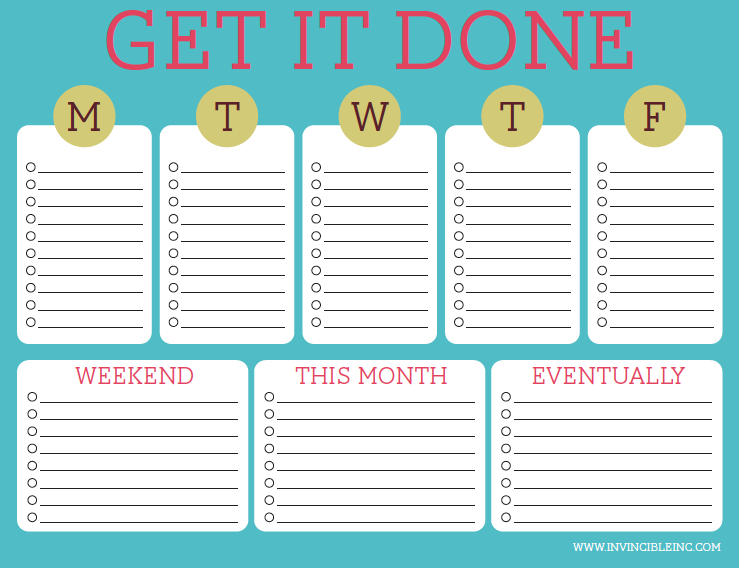
If you’d like to join me this week, here’s what you do. Read Agota’s guest post on Productive Superdad, taking note of the FAQs at the end. Choose a means of making your lists. I’ll be using paper for the monthly and weekly goals and will have digital daily lists that I will print out. Create your weekly list by drawing from your monthly list. Each day (either the night before or morning of), create your daily list based on your weekly list. Cross off tasks as you do them. Like the list above? It’s not perfectly suited for this, but you can download it here.
Click here to see how my week with a daily/weekly/monthly to-do list went.
If you read my guest post on over-commitment, you won’t be surprised that I’ve been overwhelmed lately. My vacation was restful, but I returned home to a number of tasks I had put off until I got back. Another problem was that while on vacation, I fantasized about all the things I wanted to accomplish this summer. As I considered all my options, I had no idea what to do first.
Options for Prioritizing When You’re Overwhelmed
I thought about using Mark Forster’s the Final Version or Smart Pad to work through my to-do’s, but my anxiety wouldn’t let me. I thought about using Covey’s Quadrants, too, but I still felt the number of tasks to complete would be too large. I Googled “how to prioritize when you’re overwhelmed.” Mostly what I found was the usual advice–make items with a deadline a top priority, delegate when possible, yadda yadda. Nothing clicked until I found a post from Just Ask Kim (note: some cursing here) who said that we don’t have to decide the priority of everything:
Don’t worry about the rest of the list, it’s not even worth your time to number them. All you care about at this moment is knocking out #1.
She goes on to say that when we’ve identified our number one task, we have to focus on it like a laser.
Just One Thing
Kim’s post reminded me of a well-known Bible account, but made me think about it in a whole new way.
40 But Martha was distracted by all the preparations that had to be made. She came to him and asked, “Lord, don’t you care that my sister has left me to do the work by myself? Tell her to help me!”
41 “Martha, Martha,” the Lord answered, “you are worried and upset about many things, 42 but few things are needed—or indeed only one. Mary has chosen what is better, and it will not be taken away from her.” (Luke 10:40-42)
I had always thought the lesson here was that Jesus is what we ought to be focusing on. Rather than trying to get things done, we ought to be spending time in Bible reading and prayer. This interpretation is very hard on poor Martha who is understandably concerned with eating! The traditional interpretation cannot be the whole meaning of Jesus’ words, however. Scripture makes it clear that we are not to give up working and just wait on Jesus’ return. Of course, our number one priority is always to serve the Lord, but isn’t that what Martha was doing? So what was the problem?
Jesus tells Martha that she is worried and upset about many things. Boy, can I relate to that! How about you? I’ve been worried and upset about the many things that I need to get done, or even that I’d just like to get done, and it isn’t a pleasant feeling. Like Martha, I can get mighty crabby. So what’s the answer to Martha’s and my dilemma? Just pray more? You can never pray too much, but you’ve got to get to work, too! What struck me as similar between the Just Ask Kim’s comment and Jesus’ response to Martha is just one thing being needed. My aha moment was this:
When we focus on more than one thing at a time, our productivity, peace, and patience will be diminished.
My Experience With Just One Thing
A couple of years ago, I wrote about my decision to quit using a to-do list for all but the time-sensitive tasks or things that I would otherwise forget. I remember that time as one of the most productive and peaceful of my life. I started using a typical to-do list again because I was starting a new job (that I no longer have) and figured that I had so much to do that I had to use a to-do list. Looking back, I can see that I didn’t do myself any favors. When I wasn’t using a comprehensive to-do list, I focused on just one thing at a time. I didn’t worry about what I would do after I finished a load of laundry or get upset when my husband made a request that wasn’t on an arbitrary list. I just went about my day doing the one thing that was needed at the time.
I have been re-experiencing the benefits of focusing on just one thing and I can’t rave enough. My productivity, self-discipline, sense of well-being, and family relationships have improved dramatically. Before you decide to give it a try, you might want to consider the following:
Focusing on Just One Thing doesn’t mean you ignore your calendar or time-sensitive to-do’s. Checking your calendar will be one of the “one things” you do.
Focusing on Just One Thing doesn’t mean you chuck your routines or your schedule. In fact, I’ve been better able to stick to my routines as I’m not thinking about all the other stuff I have to do.
Focusing on Just One Thing doesn’t mean you have to throw away your project lists if you need them.
Focusing on Just One Thing doesn’t mean you can’t delegate. You may recognize one thing that needs to be done and can decide to assign it to your child as a chore or ask for personal or professional help in completing it.
Focusing on Just One Thing doesn’t mean you can’t plan. Again, planning may be the one thing you are choosing to focus on.
Focusing on Just One Thing doesn’t mean you don’t work on goals or projects with a future deadline. Again, it’s one of the “one things” you will focus on.
Focusing on Just One Thing means that you do not worry about what you’re going to do after the one thing you’re doing. The only exception to that is if you’re planning. Otherwise, enjoy your meal, your conversation, your family, and even your work without the angst about what comes next.
Focusing on Just One Thing means you do not have to prioritize your to-do’s. You don’t even have to write them all down! Just ask yourself what the “one thing” is and do it–even if that’s checking your list of tasks you would otherwise forget. It’s not necessarily doing the most important thing, because who knows what that is? Barak Rosenbloom blogged about this low-stress approach to using a calendar on Time Natives.
Focusing on Just One Thing means that you’re open to something else taking over as the one thing: your child gets hurt, someone comes to the door, or your husband needs you.
Focusing on Just One Thing means you are sensitive to the Lord’s leading. As I’ve been focusing on just one thing, I have heard the Lord saying, “This is the way. Walk in it.” What a blessing to know that I’m not too distracted to hear Him for a change!
Are You a Mary or a Martha?
I used to think Mary was the “spiritual” one and Martha was a control freak. Not anymore! Mary has learned the blessing of focusing on just one thing and Martha needed to learn it. Which one are you? Do you know any Mary’s?
If you give Just One Thing a try, I’d love to hear your experience!
I’m a Christian psychologist turned homeschooling mother of six. My life can be a little crazy, so I look for sanity-saving ideas to use and share. I hope you’ll read my About page to learn more.