I know. You’ve read it all before and you’ve seen it on TV. You know that you can’t get the most out of life if you have too much stuff. But you’re no hoarder. Sure, your closet and drawers and craft spaces are a bit cramped, but you’re not one of those people who never gets rid of anything.
“Why read another decluttering book?”
That was pretty much my attitude until I read the book Organizing Solutions for People with ADHD that I described in my favorite productivity books of the year post, I was completely enamored with its focus on practicality rather than Pottery Barn-beauty. After all, if it’s too much trouble to get something out of its pretty little container, you won’t use it. And if it’s too much trouble to put it back, your space will be messy in a hurry. That was me, so I was inspired to get rid of a lot of my excess stuff.
Here is why the book is not only helping me purge my home, but is helping me be more productive.
First, let me say that the spiritual aspect of the book is not for me and won’t be for most of my readers. My friend characterized it as anthropomorphic. Indeed. The author thanks objects for their service, for example. I’m all about gratitude, but I will give gratitude to Whom it is due. The majority of the woo-woo stuff is at the end of the book, thankfully, and by then you’ve come away with some real inspiration for simplifying your home and life.
#1 I’m only keeping things I love.
The author recommends asking yourself for each thing you own (especially clothing and books) if it gives you joy. For me, joy is a fruit of the spirit and not something I have as a result of wearing a particular sweater. But I got the point. I have enough clothing (and most of my readers do as well) that I don’t have to wear things that I’m not crazy about. I now ask myself,”Do I love it?”
The change that question has made is remarkable. Where I used to ask if it was “still good,” I now follow up the do-I-love-it question with “Will I wear it?” The result is I have donated or thrown away half my clothing. I was hanging on to thong underwear that I HATED, for heaven’s sake. Why? Because I had room for it. I knew I would never wear it, but I hadn’t asked myself honestly if I would. The second example was a formal dress I wore to our niece’s wedding. I wore it to a formal event for my husband’s business meeting out of the country as well. As I was packing it to take home, I realized that though I love the dress, I wouldn’t wear it again. The next formal occasion will likely be a family or business event and I won’t want to wear the same dress. I will want to buy new. So I donated the dress.
How does this apply to productivity?
First, I’m already enjoying a time savings. I didn’t realize until I got rid of so much clothing how much time I spend deciding what to wear. I’m a pretty decisive person, but when you go through things that you don’t like for one reason or another, it wastes time. Now I know that I love everything in my closet. As long as it’s appropriate for the season, I can grab and go and be happy.
The second way it applies is in principle. Just as I am not hurting for clothing, I am not hurting for free time. I do not work in a factory 12 hours a day. I don’t walk hours to get water. I am swimming in free time compared to many. So why am I spending time doing things I don’t love doing? Now don’t get me wrong. We all have to do things we don’t love doing. We have responsibilities or we can’t afford to delegate the things we don’t like to do. I’m not talking about that. I’m talking about discretionary time. Shouldn’t it be spent doing things you really love?
In the same way I asked myself if I would wear something, I am asking myself if I’m going to do it any time soon. If not, I don’t really love it (at least not right now). It needs to get off my calendar and my to-do list.
#2 My family is only keeping things they love.
The author is pretty clear on not purging for someone else (though I’ve done it without the items being missed…). Instead, I decided to teach the kids what I’d learned. I encouraged them to go through all their clothes and only keep things they really loved and were sure they would wear.
I was in awe of what happened. The kids gave away brand new clothes I had purchased for them. In the past, I would have encouraged them to start wearing these clothes so I wouldn’t feel like a fool for buying them. But it had never worked anyway. I learned that no matter how much my boys want me to shop for them, I won’t do it. They will be coming to the store, choosing clothing, AND trying it on. They ended up keeping only the clothes I see them wearing.
My husband hung out in the bedroom with us while we went through clothes. It so happens that he keeps clothing in half the boys’ closet. He has had some of the clothes there for at least 25 years! I have NEVER been able to get him to part with them, though he doesn’t wear them. This time I asked him if he loved each piece. He insisted on touching most of the clothes (just as the author suggests) and he got rid of more clothing in half an hour than he has our entire married life!
I applied the same principle to the kids’ books. If they didn’t love them and weren’t going to read them, I had them remove them from their bookshelves. Now know that I’m a book lover. Some of the books I rescued to go on the future grandma shelf. The fact is that I do love some of those books and do plan to read them again. So that counts.
How does this apply to productivity?
First, I’m saving myself some time. The younger boys protest each week that they don’t have anything to wear to church. Why? Because they have too many clothes. They can’t decide. Now that their closets hold only clothes they will actually wear, I don’t have to run to the rescue every week. This time savings will continue to accrue as I purge more and more of our unloved things. We will have half the mess to clean up!
Second, I’m teaching my children a principle that will serve them well as they manage their own responsibilities.
#3 I’m folding clothes the right way.
I thought I WAS folding clothes the right way. I had purchased these folders for the kids that allowed them to put clothing neatly away. But it turns out that I was making more work for myself. Not only does folding the traditional way obscure what you own (so you end up buying more stuff than you need), but it makes a big mess when you remove something from the drawer.
Here is a demonstration of how to fold shirts the right way!
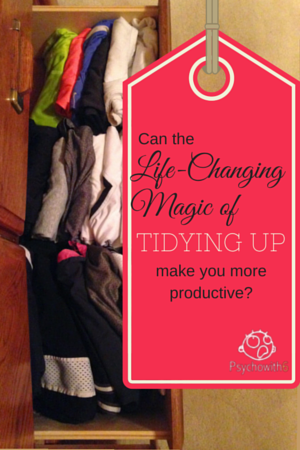
The graphic at the top of this post shows my workout clothes drawer with everything folded using this method. The bottom part of the drawer is folded more loosely because I don’t have as many shorts I love as shirts. I still have quite a few shirts, but I love and will wear them all. Promise! One thing I have noticed, though, is that I do go back and remove something I thought I wanted to keep. You will, too.
The kids took to this method immediately and love having organized drawers. In fact, their drawers look so empty that they didn’t make for good photos!
How does this apply to productivity?
First, I save time choosing clothes from my drawer and putting them away. I also don’t have to get on the kids as much about getting their laundry put away.
Second, I am realizing how important it is for everything to have an accessible space. That goes for tasks, too. One of the hacks I shared is to make sure your work space is comfortable. Make sure your tools are easy to use and put away and you will be motivated to get more done. I actually enjoy putting my clothes away and I enjoy writing every morning because the space is accessible.
I have read so many productivity and organizing books that I started to think I can’t learn anymore, but boy was I wrong! It isn’t that the concepts are completely new; it’s that the personal insights and presentation are. I had a hard time limiting myself to six, but here are some great productivity books for you to read this year and why I’m crazy about them.
I was very surprised that this book, which helps you evaluate your productivity habits regardless of your approach, was so enlightening. For example, one habit is collection. This is the idea that you need to collect all of your to-do’s into one trusted system. This is so obvious, but David Allen helped me see that my failure to do this was giving me grief. I’ve been using some kind of task management system for a long time, so I thought I would get high marks in this area. Wrong!
The evaluation in the book helped me see that I was not collecting phone, text, or IM-related tasks. Thus, I was forgetting them! I am now immediately adding them to my system, which at present is ToDoist.
There were other reasons I loved the book, not the least of which is its use of research to support best practices for getting more done. Francis Wade wrote a guest post in which he explains how we can get even more done if we’re already productive.
This is a book you’ll want in your library, regardless of the app or system you’re using at the time.
I cannot even describe how much I love this book. This book is the natural sequel to FLYLady’s Sink Reflections. I don’t believe I have ADHD, but the author makes it clear that you don’t have to have it to benefit from these organizing principles.
I think I can summarize the premise of the book this way: organize for how you will behave rather than how you’d like to behave. In other words, you may wish you would take the time to put things back into beautiful, stacked Pottery Barn containers, but the truth is you will shove it back into a cabinet, wherever there is room. So make room! Drastically declutter.
I am following the home storage solutions 101 calendar for decluttering this year and I am drastically decluttering. Here’s an example. I have a large number of expensive kitchen appliances that I needed when I was really into healthy eating (why I’m not obsessed with this anymore is a post for another time). While I keep telling myself that I’m going to make homemade jerky and tortillas and bread with wheat flour from my mill, but I don’t. These appliances take up enormous room in my kitchen and mind. Every time I see them, I feel like a failure. No more! They served a purpose at one time in my life and now I’m going to bless someone else with them.
There is more to this book than I can describe here, but I can’t recommend it enough.
I am easily overwhelmed by all the things I have to or would like to do. Most people have heard of the 80/20 principle (that 80% of the rewards come from 20% of your efforts). Keller makes it that much simpler: choose the one thing that will make everything else easier or eliminated.
I heard about Essentialism after I read The One Thing. I worried that it would be redundant. It wasn’t.
My biggest takeaway from the book is that I want to BE an essentialist rather than do a few things to simplify my life. I want to replace the nonessentialist thinking of I have to, everything is important, and I can do it all with I choose to, only a few things really matter, and I can do anything, but not everything. The last two are particularly important for me. As hard as it is to admit that I can’t do it all (and that it doesn’t even matter that I can’t), there is great freedom there too.
Essentialism is a book I need to reread regularly. I think you’ll want to be an essentialist, too, if you give it a read.
Loren has guest blogged for Psychowith6 on productivity before and I’m a huge fan. He recently completed his ebook which is free to subscribers. I have to tell you that I’ve read a huge number of books on procrastination and I wasn’t expecting much, but this book is really valuable if you are a Christian who struggles with putting things off.
My favorite tip from the book was to visualize yourself in the process of working toward your goal and not just achieving the goal. As I work on my curriculum, I keep fantasizing about the day when the first volume is complete. That’s great! But it makes the day-to-day fanny-in-chair stuff seem that much more unpleasant. Now I visualize myself writing and learning how to complete the project.
That brings me to another insight from the book which was HUGE for me. Loren writes that many people procrastinate because they don’t have a growth mindset, but more of a pass/fail one. In other words, some people put things off when they discover a task doesn’t come easily to them. They assume that they “just aren’t good at it” so there’s no point in continuing. I realized that this is me! I approached my blog that way. When I didn’t have instant success, I thought I wasn’t good at it, and waffled about continuing. Now, of course, I know that like most things, it’s something you can improve on. Most importantly for me, I realized that I had a pass/fail mindset about the curriculum I’m writing. I was wondering if I would be good at it or not. That set me up to procrastinate. Now I’m approaching it as something that will be challenging at first, but that I will grow into.
I believe you’ll gain insights in your procrastination and how to stop, too.
I listened to this book via Audible when I was on vacation and it was just what I needed. While it is geared toward creatives (and is rated PG for language), I found the admonitions to unplug and give myself time to think incredibly valuable.
The book does offer good ideas for building routines as well. But I do pretty well at that already. What I don’t do as well at is giving myself margin. As a result of reading the book, I plan to take Sundays off and unplug. That may be challenging at first, but I’ll grow into it. It’s not a pass/fail, right?
What productivity books did you read last year that you recommend?
I don’t know about you, but with all the holiday happenings, my hot spots have been blazing out of control. What’s a hot spot you say? FLYLady would tell you it’s a place in your home where you tend to drop things and run. Unless you regularly clear these places or devise a plan for keeping them clear, you can have a hot mess. In just a few simple steps this week, we’ll take care of our hot spots.
#1 List all hot spots; identify the worst
With your family, make a list of all the places where stuff tends to accumulate. In our home, that’s our entry way, dining room table, upstairs landing, and entrance to the storage area. Right now the worst is the entrance to the storage area.
#2 Clear a hot spot & prevent it from heating up again
Work on your worst hot spot today. Declutter it and clean it. Teach the kids where to put items. Our dining room often becomes a hot spot because the kids don’t know where to put the mail that is often left there. I have been teaching them to put it in my mail slot in my kitchen. Problem solved. Need ideas for managing paper clutter? Be sure to read my advice on Davonne Parks’s blog.
How can you prevent it from becoming a mess again? I have two suggestions. First, come up with a practical way to collect the clutter. For example, I repurposed a toy chest into a place for winter coats in my entryway. The kids don’t want to take the time to hang them, so I accepted that and allow them to stuff them out of sight. Do you need a basket to collect items that can be sorted later? Ask the kids and your spouse what would work and give it a try. You can also find great hot spot prevention ideas on my Organized Homeschool board on Pinterest.
You can always evaluate the success of your first effort at controlling the hot spot later and try something else if need be.
The second suggestion I have is to make clearing the hot spot a chore that is done once or twice a day. Our entryway is assigned as a chore twice a day, for example, and these two suggestions have kept the area from becoming a disaster.
#3 Clear another hot spot & prevent it from heating up again
You guessed it. Now that you’ve addressed your biggest hot spot, move on to the second biggest.
#4 Clear another hot spot & prevent it from heating up again
Now you’re a pro. Clean a third hot spot and determine a way to keep it clean.
Do you have any hot spot dilemmas? Areas that you just can’t seem to keep free of clutter?
Most homeschoolers rely on their computers. We use them for:
curriculum
research
creating
communicating
worship (I play a family worship CD on our computer)
and much more…
The problem is neglecting our computers until they give us fits.
This week’s challenge is all about making sure they work for our homeschools and not against them.
#1 Create a Safety Plan
We took steps to keep our photos and videos safe during the Memory Keeping Challenge. This week, we will take steps to protect our other valuable files: documents, records, music, contacts, and more.
Fortunately, most computer programs have automatic backups these days. Unfortunately, some programs require you to indicate that you want automatic backup ON in your settings. Never assume that your files are being backed up — that goes for your mobile devices as well. Take a few minutes to make sure they will be there if your computer isn’t.
Determine how to back up files. I prefer to have files backed up online. I use Dropbox for many different kinds of files. If you’re comfortable with your files being backed up online, add at least one more level of safety. My huge list of Gmail contacts became corrupted. I hadn’t made a backup of them. Never trust an online account to be your only backup of vital information. You may want to consider an external hard drive (or two) as a backup.
Make sure your security software is up to date. Anyone who’s had a computer completely destroyed by viruses (me!) will tell you that it pays to download the latest version of your software program of choice.
Create a safety plan for your kids. There are many excellent methods of limiting kids’ exposure to online predators and pornography. I’ve reviewed many of them. But I believe the most effective method is educating our children.
Explain to kids that there are unscrupulous people who would like to exploit their natural curiosity and desire for relationships. Clicking on an ad or sharing personal information can lead to unintended problems. It’s really important to tell children that if they do come across pornographic material or give personal information to a stranger, that you will NOT be angry with them. Instead, you want them to tell you, so you can prevent the incident from becoming a serious problem.
Of course, this kind of education should be ongoing with information and discussions taking place when children reach a new stage of development. This video addresses internet safety in general.
#2 Maximize Performance
You need all your patience to teach and parent; you can’t afford to deal with a slow computer, too.
If you have a slow internet connection, spend some time researching an economical option. And don’t be afraid to pray! We had problems with our network for months until a friend at church, who works for our internet company, saw my Facebook update about it. He sent someone out who finally determined and fixed the problem.
Educate the kids not to agree to download extra adware when getting games or software online. This has been a primary cause of slowness on our PCs.
A messy computer desktop can be just as overwhelming as a cluttered work space. If you’re using a PC, you don’t really need those program icons. Deleting them shouldn’t delete your programs, which can be run from the task bar or start menu. Everything in its place applies to computers, too.
The quickest way to clean your desktop is to create a folder and label it archive. Drag everything into it that you think you may need and go through it later when you have a folder system set up. Mark Hurst describes this approach in his free Kindle book, Bit Literacy .
Use a desktop wallpaper. IHeartOrganizing shares a file-naming strategy and pretty desktop wallpaper (just a photo that you set as your desktop) that you can use for organizing files you’re actively working with.
#4 Declutter Unneeded Files
Take 15 minutes and delete files you don’t need. To make this practice easier in the future, consider having a “To Delete” file. I often download files I know I won’t need later to this folder.
As homeschoolers, we can find it difficult to minimize the collection of stuff. Here are a few reasons why:
Books are often our greatest treasure; we can’t imagine giving them away
We may have more than one child or might have, so we figure we will need the toys, the clothing, and the curriculum again soon
We need to save two-liter bottles, empty milk containers, and toilet paper rolls for those experiments and crafts that use “what you have on hand”
We may do unit studies and could use just about anything as a prop or costume
We don’t want to waste money living on a single income or just to be good stewards
Although we can come up with good reasons to keep our stuff, there are also good reasons to get rid of it:
If we keep buying bookshelves, we will have to buy a larger house
Organizing hand-me-downs can be very time-consuming
If we save too many recyclables, we might start thinking that having 20 cats is normal, too
It’s no use saving so many things to use for unit studies if we can’t find them
Clutter can cost us emotionally, socially, financially, and spiritually
We can’t clear years’ worth of clutter in a week, but we can get a good start on it. This week:
#1 Make a List of All Gifts Received for Christmas
I receive a few gifts for Christmas, but I buy most of my clothing and other items I need at the end of the year because of sales. If I don’t declutter as much as I take in, it won’t take long for me to look like a hoarder. The same goes for the kids.
Enough time has gone by that it will be an interesting exercise to have your children make a list of everything they’ve gotten during the Christmas season. I’m providing a form for subscribers for this purpose. If they can’t remember, what does that tell them about the real value of things?
#2 Collect Items to Declutter Based on Your Gifts Received List
The idea is to do a one-in, one-out exchange. If you got a new sweater, an old one is decluttered. If the kids got a new game, an old one is given away. If you can’t do that for some reason, just declutter any item in exchange for the new one received.
I had a very difficult time with this where the kids were concerned for many years. One child would get a toy as a gift and everyone played with it. This is great until it comes time to declutter. The teen no longer cared about the younger kids’ stuff, so he would want to declutter it, much to his siblings’ dismay.
I now lay two blankets on the floor when we are decluttering kid stuff. One blanket is for anything any child wants to give away. The other is for trash. The kids enjoy going through their stash of toys and games and putting items on the blankets. As a child sees something on the blanket he wants to keep, he rescues it and returns it to storage. As the process continues, he may change his mind and return it to the giveaway pile, however. Sometimes kids are ready to release things when they feel free to choose. I may also rescue items from the blanket that I want to sell or keep for grandchildren (I’ve changed my mind about many of these latter items with my husband’s encouragement.)
#3 Put Unwanted Books/Curriculum Aside or List for Sale
Once, when I had more books than bookcases, I went through boxes of books while on the phone with a friend. I would explain to her why I was keeping each book. It wasn’t long before I realized that I didn’t need to be everyone’s library. So much of the time I was keeping books in case someone wanted to borrow them. I encourage you to ask yourself why you’re keeping books and release those that hold no interest, no sentimental value, or will not be read again.
Can we talk about releasing curriculum now? It’s tough to admit you spent hundreds on something you hate or that your kids will never be cute little kindergartners again, but you’ll have so much more peace in your homeschool when it’s out of sight. If you declutter something you end up wanting again, you can always buy it (or borrow it) again.
At this point in the school year, you know which materials you purchased that just aren’t working. Box them up to sell at spring or summer used book sales or list them for sale now. Check out my post on the best places to sell used curriculum.
#4 Deliver Unwanted Items to Charity, Consignment, or the Post Office
Unless you’ve determined that later in the year is a better time to offload your unwanted items, do yourself a favor and send them to a new home as soon as possible.
In our area, many charities will pick up donations. I usually prefer to free up space by sending my husband to the drop-off location (which he gladly does).
My favorite resource for decluttering inspiration is FLYLady.net or her book, Sink Reflections. My one claim to fame is that I have a blurb on the back.
I’m a Christian psychologist turned homeschooling mother of six. My life can be a little crazy, so I look for sanity-saving ideas to use and share. I hope you’ll read my About page to learn more.